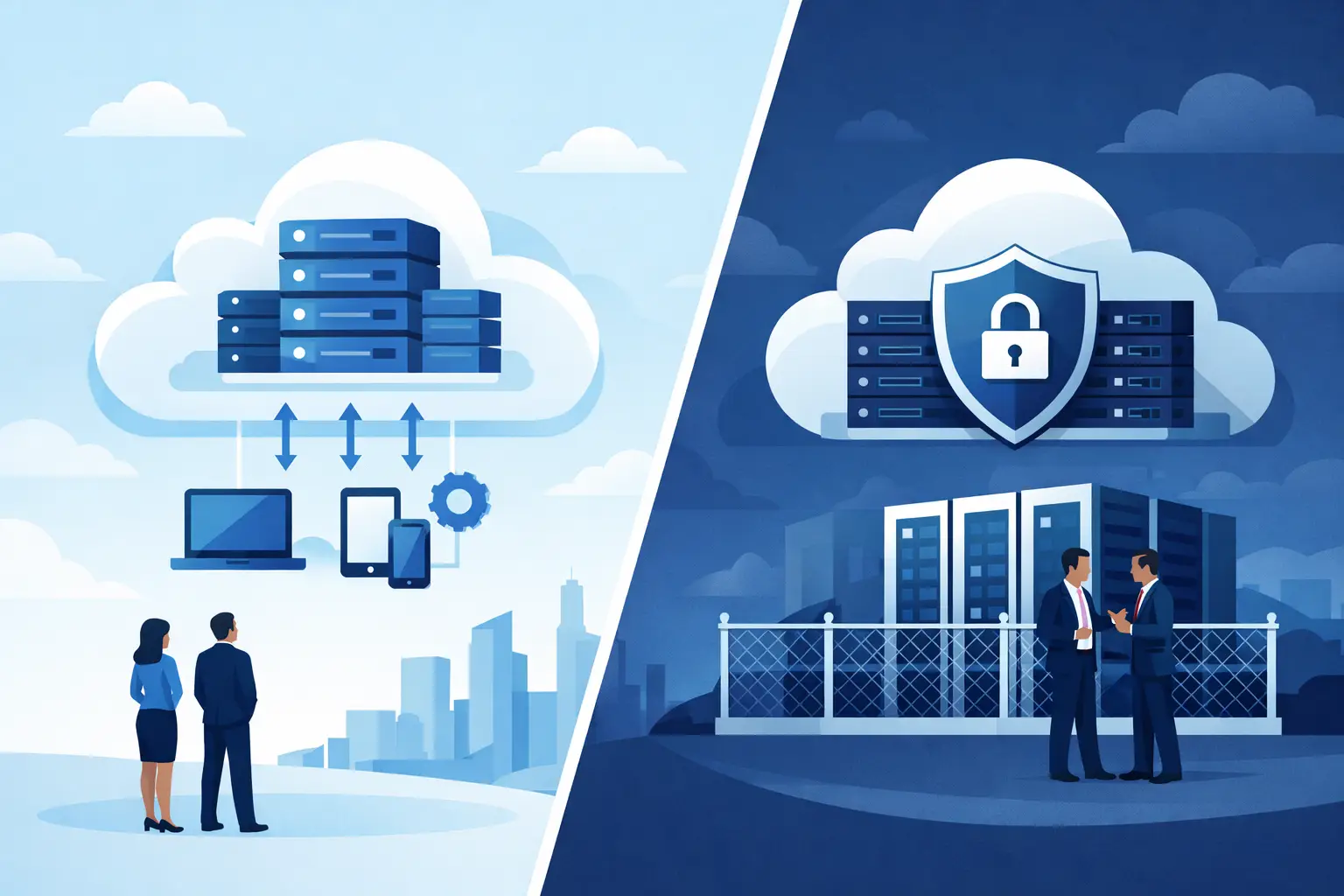
An environment that works well in a proof of concept can become a source of costs, latency, and complexity when scaling. Therefore, the decision between public cloud vs private cloud should not stem from a technological preference or an isolated business requirement. It should respond to how the company operates, what data it processes, what level of availability it needs, and what internal capacity it has to govern its infrastructure.
The public cloud offers speed and elasticity. The private cloud provides control and isolation. Neither is superior by definition. The right choice depends on the operational, regulatory, and financial requirements of each workload.
Public Cloud vs Private Cloud: The Operational Difference
The public cloud provides computing, storage, networking, and managed services from a shared infrastructure operated by a provider. Although physical resources are shared among clients, each organization has logically isolated environments. This model allows for provisioning capacity on demand and paying, largely, for the consumption made.
The private cloud, on the other hand, reserves the infrastructure for a single organization. It can be hosted in the company's own data center, in third-party facilities, or through a managed dedicated platform. The decisive element is not where the hardware is located, but that the company maintains an exclusive environment and a greater ability to define its configuration, access policies, and operational controls.
This difference affects the way of working. In the public cloud, the provider takes on a significant part of the physical operation and provides advanced services that reduce platform work. In a private cloud, the organization gains more direct control but also assumes more responsibility for capacity, maintenance, updates, and continuity.
Cost: Flexible Consumption vs Predictable Investment
The public cloud often reduces the initial barrier to entry. It does not require purchasing servers or sizing a data center before validating an initiative. It is especially useful for products with variable demand, analytics projects, development and testing environments, or platforms that need to grow quickly.
However, paying for usage does not automatically mean paying less. An application with stable and high loads, oversized resources, storage without lifecycle policies, or frequent data transfers can generate a bill that is hard to justify. The problem is not the public model, but the lack of discipline in architecture and FinOps.
The private cloud requires a higher initial investment or a longer contractual commitment. In return, it can offer more predictable costs when usage is constant and the company operates mature applications with known capacity needs. This predictability is valuable in core systems that process a sustained volume of transactions over the years.
The comparison should be made on the total cost of ownership. This includes licenses, specialized personnel, support, monitoring, backups, disaster recovery, connectivity, security, and the opportunity cost of keeping equipment busy with infrastructure tasks. Comparing only the price of a virtual machine with that of a dedicated server leads to incomplete decisions.
Security and Compliance: The Responsibility Model Matters
The private cloud is often perceived as the more secure option because it offers an exclusive environment. Physical isolation can be relevant for certain sectors and contractual requirements. Still, exclusivity does not guarantee security. A private environment without patching, segmentation, event logging, identity management, and recovery testing can be riskier than a well-designed public platform.
The public cloud incorporates mature security capabilities but operates under a shared responsibility model. The provider protects the data centers and base services; the company remains responsible for configuring permissions, encryption, networks, secrets, backups, and retention policies. Many cloud incidents stem from misconfigurations, not from failures in the provider's infrastructure.
To decide, it is advisable to identify what the organization really requires: data residency, traceability, segregation, audits, document retention, encryption with own keys, or restrictions on who can manage the systems. Some requirements can be resolved in the public cloud with a rigorous architecture. Others justify a private or dedicated infrastructure.
Scalability and Performance: Not All Loads Behave the Same
The main advantage of the public cloud is elasticity. It allows for scaling resources in minutes during traffic spikes, launching services in new regions, and using managed components without building them from scratch. For teams developing digital products, this speed can significantly shorten the time between a business decision and its production deployment.
The private cloud often fits better when performance needs to be very predictable, latency is critical, or applications depend on local systems that are difficult to move. It can also be suitable when there are intensive legacy integrations, large volumes of internal data, or teams that need precise control over hardware and network configuration.
However, scaling a private cloud requires capacity planning. If the business grows sooner than expected, acquiring, installing, and validating new resources takes time. In the public cloud, the risk changes: capacity is available, but control must be applied to prevent automatic scaling from multiplying costs without adding value.
The Burden of Legacy Systems
Organizations with legacy applications should not approach migration as a direct server transfer. Replicating a monolithic architecture, with rigid dependencies and manual processes, in the public cloud can transfer the same problems to a variable monthly bill.
Before moving a workload, it is necessary to evaluate its dependencies, its consumption pattern, the sensitivity of its data, its recovery objectives, and the team's ability to operate it. Sometimes, partially modernizing an application or exposing functions via APIs offers more value than a total migration. In other cases, temporarily maintaining a system on private infrastructure reduces risk while building a viable alternative.
When to Choose Public Cloud
The public cloud is often a solid decision if the company needs to launch products quickly, absorb irregular demand, access managed data or artificial intelligence services, or reduce the burden of managing physical infrastructure. It also fits when a geographically distributed presence is required without building data centers in every market.
For it to work well, infrastructure as code standards, centralized identity management, resource tagging, observability, budgets, and deployment controls are needed. Elasticity without governance quickly becomes technical sprawl.
When to Choose Private Cloud
The private cloud makes sense when there are strict isolation constraints, very low latency, specific sovereignty requirements, or stable usage that makes dedicated capacity cost-effective. It is a reasonable option for critical platforms that cannot rely on external connections or for environments where integration with local assets is crucial.
It may also be appropriate for companies that already have a mature infrastructure operation and want to retain direct control. But that control must be backed by processes: vulnerability management, automation, recovery testing, continuous monitoring, and a technology renewal strategy. Without these capabilities, the private cloud can turn into a more expensive and harder-to-evolve data center.
The Hybrid Architecture is Often the Practical Answer
Many companies do not need to choose a single model. A hybrid architecture allows for keeping certain workloads on private infrastructure and using the public cloud for development, data analysis, disaster recovery, seasonal capacity, or customer-oriented digital services.
The hybrid approach should not be confused with accumulating platforms indiscriminately. It requires defining which workloads go in each environment, how they connect, where the source of truth for the data resides, how identity policies are applied, and how costs and performance are monitored end-to-end. If those boundaries are not clear, complexity can outweigh the benefits.
At StrateCode, this type of decision is addressed by linking architecture and operation: application inventory, dependency assessment, data classification, cost modeling, and a phased migration plan. The goal is not to move everything to the cloud but to build a platform that can evolve without jeopardizing business continuity.
A Decision That Should Be Reviewed with the Business
The choice between public and private cloud is not permanent. A product can start in the public cloud to validate the market and move certain workloads to dedicated capacity when its usage pattern stabilizes. Similarly, an organization with its own infrastructure can use public services to modernize its data processes without immediately replacing its core systems.
The best decision is the one that turns business requirements into verifiable technical criteria: availability, recovery time, latency, cost per transaction, data protection, and delivery speed. When those criteria are defined, the conversation shifts from a discussion about providers to an architectural decision with measurable impact.