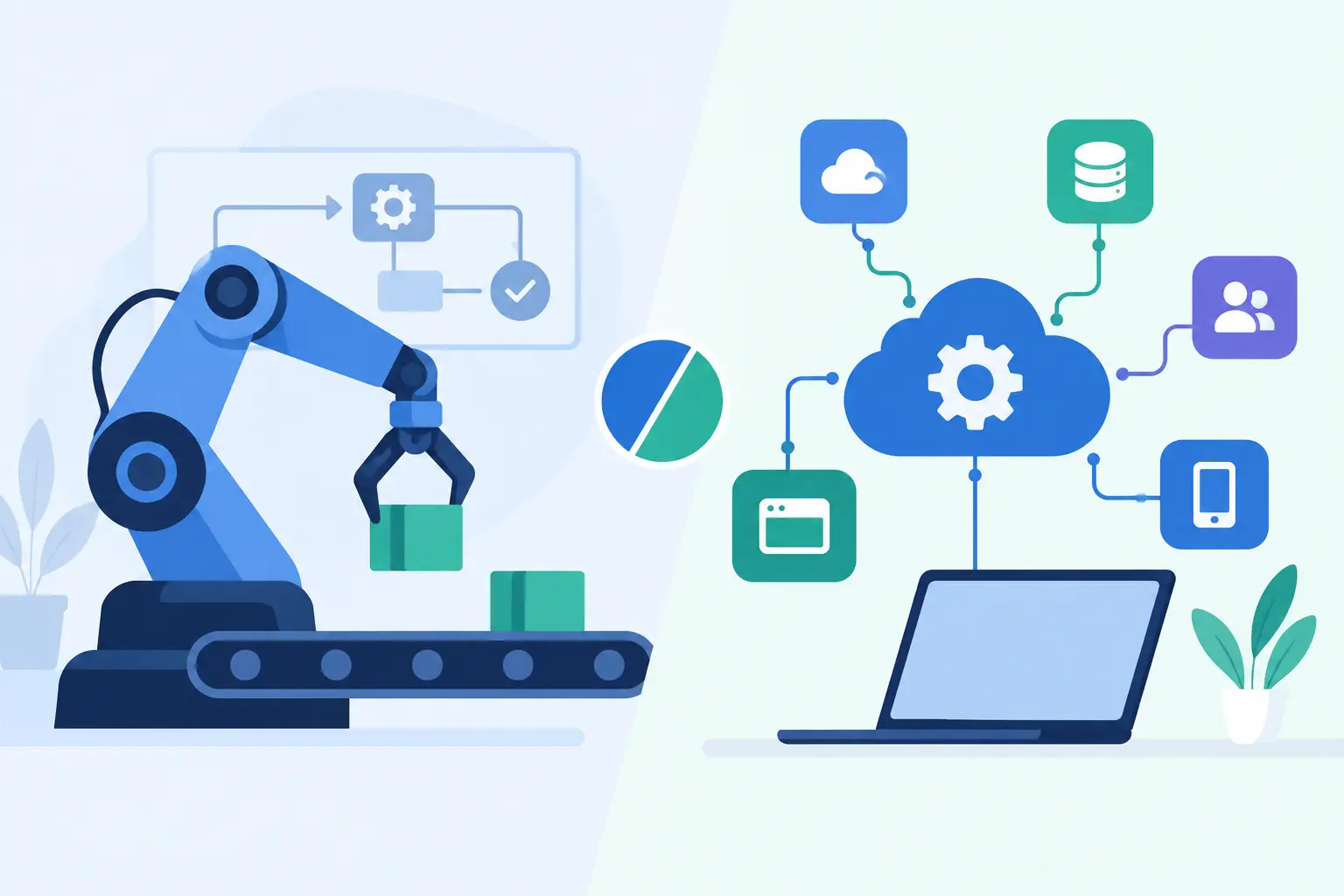
A finance team receives sales data every morning from a supplier portal, copies it to a spreadsheet, and uploads it to the ERP. The discussion of robotic automation vs API integration is not a theoretical one in this case: it determines whether the company eliminates a repetitive task in weeks or builds a reliable flow that will continue to function when the volume multiplies.
The right answer is rarely to choose a technology based on preference. It depends on where the data resides, which systems offer integration capabilities, how much the process changes, what the cost of an error is, and what lifespan is expected from the solution. For operations and technology managers, the decision should stem from architecture and business impact, not from an attractive demo.
What Each Approach Solves
Robotic Process Automation, known as RPA, uses software robots that replicate a person's actions on an interface. A robot can log into an application, open a screen, enter data, download a file, validate fields, and send a notification. It is especially useful when there is no better technical way to interact with a system.
API integration connects applications through interfaces designed to exchange data and execute operations. Instead of clicking buttons or reading a screen, a service requests information or sends an instruction directly to the target system. For example, an e-commerce platform can create orders in the ERP via an API, and the ERP can return inventory status without human intervention.
The difference seems simple, but it has relevant consequences. RPA operates on the presentation layer, which is designed for users. APIs operate on the service layer, with technical contracts, authentication, validation rules, and structured responses. One may be the fastest route in the face of a specific limitation; the other usually offers a more suitable foundation for critical and high-volume processes.
Robotic Automation vs API Integration: Operational Differences
The main strength of RPA is its ability to work with legacy applications, remote desktops, third-party portals, or tools without available APIs. If a team spends hours transferring data between closed systems, a robot can reduce manual work without requiring an immediate transformation of the entire environment.
However, that proximity to the interface also introduces fragility. A change in screen design, a renamed field, a pop-up window, or a new access policy can stop the robot. Maintenance is not an operational detail: it must be budgeted and assigned to a responsible team. Additionally, robots require credential management, monitoring, exception handling, and audit logs.
APIs often require more initial work. One must understand data models, define mappings, manage credentials and permissions, control usage limits, design retries, and handle errors securely. When multiple systems are involved, it is also necessary to decide where business logic resides and how information consistency is maintained.
In return, a well-designed integration is more predictable in the face of interface changes, processes greater volume, and allows for real technical observability. It can log every request, measure latencies, identify failures, and reconstruct what happened with a specific piece of data. For billing, orders, inventory, reconciliation, or customer synchronization processes, this traceability often justifies the initial investment.
When RPA is the Right Choice
RPA fits when the problem is clearly defined and the interface is the only viable access point. It also makes sense to automate internal tasks with moderate volume, stable rules, and an urgent need to free up operational capacity.
Consider a back-office team that must consult an external portal, download documents, and update an internal system without the possibility of direct connection. Waiting for the provider to publish an API can prolong a real problem for months. A well-controlled robot can provide a temporary solution or, in some cases, a permanent one if the process is not strategic and does not change frequently.
The key is not to confuse speed of implementation with lack of design. Before automating, it is advisable to simplify the process, eliminate avoidable exceptions, and define what happens when the robot encounters incomplete data, a down service, or a different screen. Automating a flawed process only allows the error to propagate more quickly.
When API Integration Offers More Value
An API is often the preferred option when data exchange is part of the core functioning of the business. If orders, payments, inventory, customer service, or the supply chain depend on updated data, direct integration reduces reliance on fragile interfaces and decreases processing times.
It is also the right path if the process needs to grow. A robot can effectively perform sequential operations, but an integration can be designed to work by events, process batches, apply queues, and absorb demand spikes. This becomes crucial when the operation shifts from hundreds to tens of thousands of transactions.
APIs are also a better foundation for building reusable capabilities. Once access to customers, products, or orders is normalized, other systems can use that integration layer with consistent controls. The value is no longer just in eliminating a manual task, but in creating an architecture that facilitates future products, automations, and data-driven decisions.
However, having an API does not guarantee good integration. Some interfaces are incomplete, have limited documentation, impose restrictive limits, or do not expose the necessary operations. In those cases, it is advisable to evaluate alternatives such as scheduled exports, intermediate connectors, or a combination of API and RPA, rather than assuming that direct connection will resolve any need.
The Real Cost is Not Measured Only in the Initial Project
A useful comparison must consider the total cost of ownership. RPA may seem less expensive at first because it avoids developing complex connectors, but its maintenance increases if there are frequent interface changes, multiple robots, or many exceptions. Each adjustment must be tested to ensure it does not affect already stabilized operations.
API integration concentrates more effort on analysis, development, and testing, but it usually reduces manual intervention and facilitates long-term maintenance. The difference depends on the quality of the API, the maturity of the environment, and the engineering discipline applied.
There is also a cost associated with risk. In regulated or financial processes, a robot that misinterprets a screen can generate hard-to-detect errors. An API integration does not eliminate risk, but it allows for schema validations, idempotency controls, detailed logs, and alerts on failed transactions. For processes with economic or contractual impact, these capabilities have direct value.
A Decision Framework for Business and Technology Leaders
Before approving an initiative, it is advisable to answer some specific questions. Is there an API that covers the necessary operations and is supported by the provider? Is the process strategic, recurring, and predictable for several years? What is the current and expected volume? What happens if an operation fails halfway? What evidence is needed for auditing? Who will maintain the solution when a system changes?
If the answer points to high volume, criticality, growth, and need for traceability, API integration should be the starting point. If access is limited to an interface, the process is stable, and a quick improvement is needed, RPA may be a reasonable decision. When there is a mix of modern and legacy systems, a hybrid approach is often the most pragmatic: APIs for available services and RPA only where there is no other option.
The choice should also consider operational ownership. A robot without monitoring becomes a deferred manual task: someone will discover the failure when the data does not arrive. An integration without clear contracts or change management will suffer the same problem. In both cases, responsible parties, availability metrics, alerts, testing, and a recovery procedure are needed.
Designing So Automation Does Not Create Another Technical Debt
The most common mistake is treating each automation as an isolated solution. Over time, robots that depend on specific machines, scripts that no one understands, shared credentials, and flows that transform data without a clear source of truth emerge. The result is a new layer of complexity over systems that were already difficult to maintain.
A mature implementation first defines the target process and its rules. It then identifies record systems, data owners, dependencies, exceptions, and security requirements. Only then does it select the technology. This order prevents the tool from conditioning the architecture.
At StrateCode, this type of decision is approached by connecting the immediate use case with the future state of the platform. A robot may solve the current operational pressure, but it must be clear whether it will be a temporary solution, what dependency it creates, and what the path is to replace it with a more stable integration when feasible.
The best decision is not the one that automates the most steps in the least time. It is the one that reduces operational load without compromising reliability, security, or the ability to evolve. Starting with a measurable process, with a clear owner and defined success criteria, allows demonstrating value before extending the model to the rest of the organization.