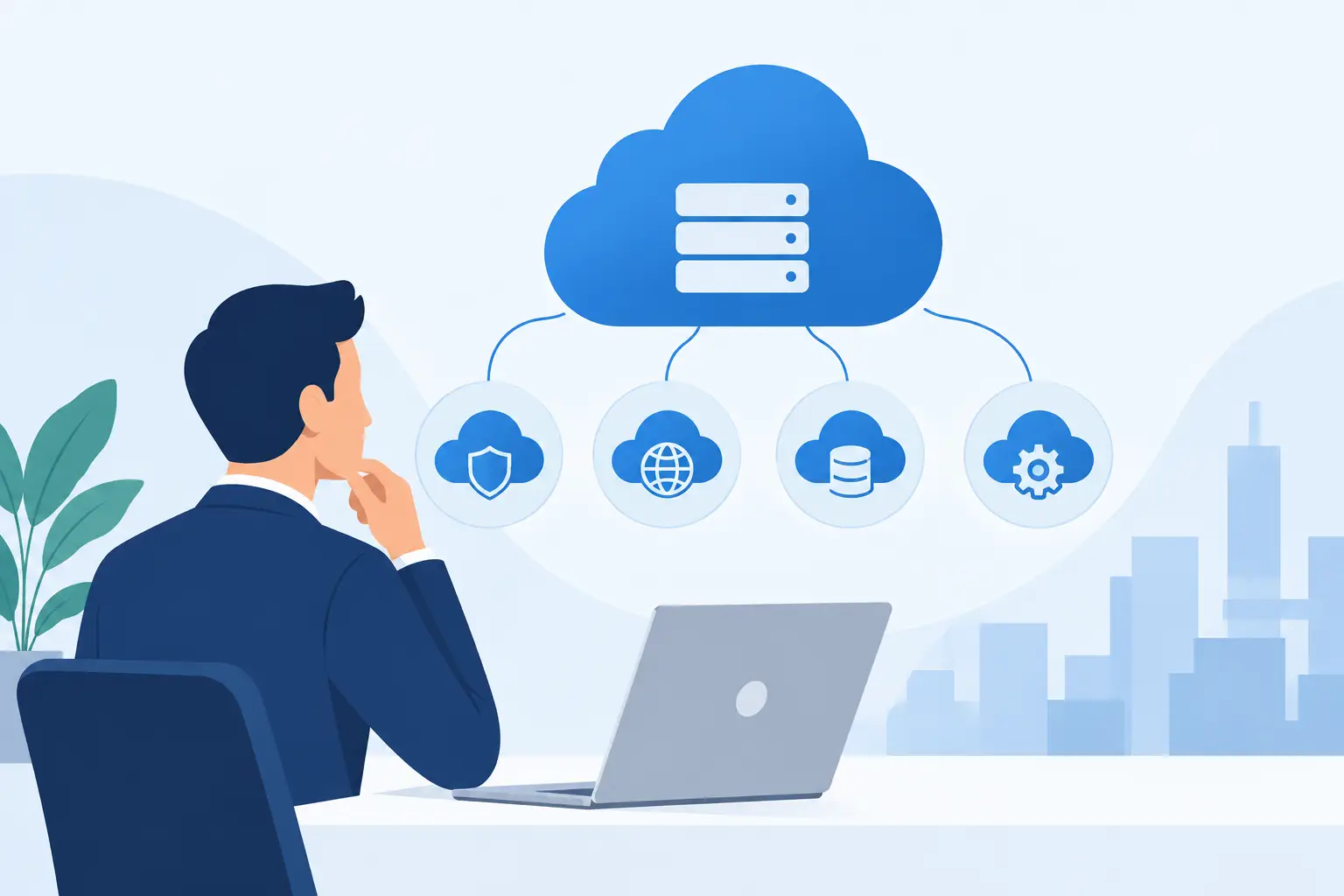
A company with slow applications, servers nearing end-of-life, and data scattered across departments does not solve its problems by moving everything to a cloud provider. The enterprise cloud can reduce operational friction and improve responsiveness, but only when it aligns with a clear architecture, governance model, and business priorities.
The most common mistake is not choosing the wrong provider. It is starting a migration as if it were a purchase of infrastructure. For an operations, technology, or finance department, the decision should be evaluated as a change in how to design, operate, protect, and finance critical systems.
What an Enterprise Cloud Should Solve
The term cloud is used for very different realities: from corporate email and shared storage to data platforms, development environments, or applications that process business operations in real-time. Therefore, the first step is not to ask what services to contract, but what current limitations need to disappear.
In organizations that have grown on legacy systems, the same problems tend to repeat: manual deployments, underutilized capacity, untested incident recovery, dependence on one or two key individuals, and a lack of reliable data on costs or performance. A well-conceived enterprise cloud can address these risks because it allows for automated provisioning, standardized environments, scalable services, and more accurate usage measurement.
However, the cloud does not automatically correct a poor design. A monolithic application with inefficient queries will still have performance issues. A poorly defined business process will continue to generate manual tasks, even if it runs on a modern platform. And an organization without access and configuration discipline may increase its risk surface when migrating.
The useful question is specific: what operational or economic outcome needs to improve and how will it be measured? It could be reducing time to production, decreasing interruptions, accelerating business analysis, or recovering a critical service within a defined time objective.
Not All Workloads Should Migrate the Same Way
Complete and rapid migration is appealing in executive presentations, but it is rarely the most sensible option. Each application combines dependencies, regulatory requirements, data sensitivity, demand patterns, and change costs. Treating the technology inventory as a single block often transfers technical debt to a variable monthly bill.
An initial assessment should identify which systems generate the most value, which pose the greatest risk, and which are nearing retirement. With that information, the organization can decide whether to retire, maintain, relocate, modernize, or rebuild each workload.
Relocating an application to virtual machines may be appropriate when there is a time constraint, for example, in the face of a data center closure. However, this approach retains many of the operational needs of traditional infrastructure and does not necessarily leverage managed services.
Modernizing or rebuilding requires more initial investment but can reduce administrative tasks and improve evolution capacity. It makes sense for strategic digital products, processes with demand spikes, or systems where delivery speed conditions growth. The choice depends on the business horizon, not on a technological preference.
The Value of a Hybrid Architecture
For many companies, a hybrid architecture is a reasonable stage and, in some cases, a permanent decision. There may be teams, plants, applications with strict latency, or data residency requirements that advise keeping part of the workload outside the public cloud.
The goal is not to adopt a pure model. It is to establish a coherent architecture: secure connectivity, centralized identity, defined data flows, and clear operational responsibilities between environments. An improvised hybrid solution can increase complexity; a well-designed one allows for phased progress without jeopardizing operations.
Governance Before Consumption
The ease of creating resources is one of the main advantages of the cloud. It is also a common source of unexpected costs and inconsistent configurations. If any team can deploy services without tags, limits, reviews, or financial accountability, the problem appears months later when the bill grows, and no one can explain its origin.
Governance should not become a bureaucracy that hinders engineering. It should provide reusable rules that allow for safe progress. This includes an account or subscription structure, identity policies, network standards, mandatory tagging, budgets, alerts, and criteria for approving exceptions.
It is also advisable to assign clear owners. Finance needs visibility of spending by product, area, or client. Technology needs to know who maintains each service and what level of availability has been agreed upon. Security must be able to verify controls without relying on isolated manual reviews. When these needs are considered from the design stage, the cloud stops being a black box of variable costs.
The FinOps practice brings discipline to this relationship between technological consumption and financial responsibility. It is not just about negotiating discounts. It involves reviewing usage patterns, eliminating inactive resources, adjusting capacity, and making architectural decisions based on cost and performance data.
Security Designed, Not Added at the End
In traditional environments, security has often been treated as a network perimeter. In the cloud, that perimeter is no longer sufficient. Identities, credentials, configurations, and data become central controls.
The principle of least privilege must be applied to people, services, and automations. A user does not need permanent access to all environments, and an application should not have broader permissions than necessary to perform its function. Multi-factor authentication, secure secret management, and credential rotation are basic requirements, not optional improvements.
Configuration deserves the same attention. Exposed storage by mistake, overly permissive security groups, or disabled logging can compromise sensitive information without a sophisticated attack. Therefore, controls must be incorporated into the delivery cycle through infrastructure as code, automated reviews, and continuous monitoring.
For regulated environments or those with customer data, it is also essential to define information classification, encryption, log retention, and incident response procedures. Evidence of control should not be hastily constructed during an audit. It should be generated as a normal part of operations.
From Migration to Stable Operational Capacity
An enterprise cloud program does not end when the new workloads are turned on. The period after migration determines whether the investment generates efficiency or merely changes the location of the problems.
Operations need observability: metrics of availability, performance, errors, capacity, and cost that allow deviations to be detected before they affect the business. Teams also need response procedures, tested recovery objectives, and an explicit definition of who acts in response to each type of incident.
Automation plays a decisive role. Repeatable deployments reduce manual errors; integrated testing limits regressions; and infrastructure defined as code facilitates recovering environments, reviewing changes, and maintaining consistency. Without these practices, the cloud can inherit the fragility of previous processes at a faster pace.
Internal training is also part of the design. A technical partner can accelerate assessment, build the initial platform, and accompany modernization, but operational knowledge must be documented and transferred to the responsible team. StrateCode addresses these types of initiatives by linking architectural decision-making with execution, to prevent a correct strategy from being lost in incomplete implementation.
How to Evaluate Return Without Oversimplifying
Comparing the monthly bill from the provider with the current cost of servers offers an incomplete view. The return must consider maintenance, licenses, support, time spent by teams, interruptions, hardware renewal risk, and opportunity cost of not launching improvements on time.
At the same time, it is advisable to avoid generic promises of savings. In stable and predictable workloads, a poorly sized cloud environment can cost more than an amortized on-premises infrastructure. In applications with demand variations, geographical expansion, or need for rapid delivery, the value may lie more in elasticity and reduced change time than in direct savings.
Metrics should be agreed upon before execution: deployment frequency, recovery time, cost per transaction, availability, reduction of manual tasks, or time needed to enable a new client. Measuring these indicators allows for course correction and justifying subsequent decisions with evidence.
The best decision is not to move everything to the cloud or to keep everything as it is. It is to build a platform that allows the company to operate with less risk, clearer data, and real capacity to change when the business demands it. That work begins with an uncomfortable but useful question: what part of the current technology is limiting the strategy, and what technical change would sustainably resolve that limit.