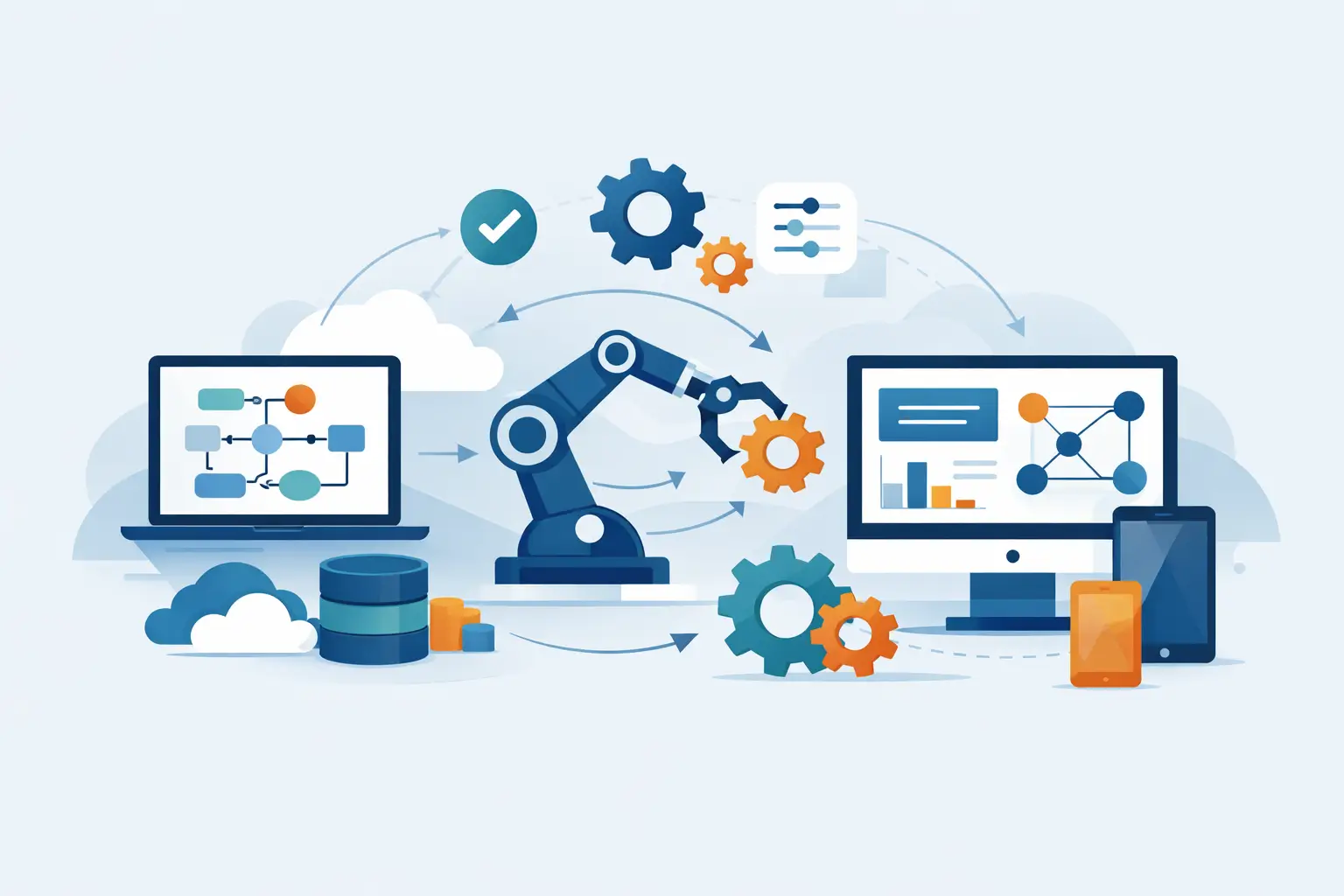
An approved order in the CRM that someone must re-enter into the ERP. A finance team downloading spreadsheets to reconcile invoices. An inventory alert arriving late because it depends on a manual check. These are seemingly small frictions, but when accumulated, they generate errors, delays, and costs that are hard to attribute. Understanding how to automate processes between systems involves eliminating those friction points without creating a fragile, opaque, and costly network of integrations.
Useful automation is not limited to moving data from one application to another. It must preserve the meaning of the information, apply the correct business rules, leave traceability, and respond predictably when an external system fails. To achieve this, it is advisable to treat integration as an architectural and operational decision, not as a one-off development task.
How to Automate Processes Between Systems Without Creating Technical Debt
The first common mistake is starting with the tool. Before choosing an integration platform, an automation solution, or an API, the complete process must be defined: what initiates it, which systems are involved, what data is needed, who validates exceptions, and what result is considered correct.
A customer onboarding flow, for example, may involve a web form, a CRM, a tax validation tool, an ERP, and a support system. If each connection is implemented independently, any change in fields or business rules can break the process. The alternative is to design a flow with clear responsibilities and explicit data contracts.
It is also important to distinguish between automating a task and redesigning a process. Replicating an inefficient manual sequence in software can accelerate the problem rather than solve it. If three departments modify the same customer data, the issue is not just synchronizing it: it is deciding which is the master system and under what conditions the others can update it.
Start with Processes with Measurable Impact
Not all candidates for automation offer the same return. The best initial cases often combine volume, repeatable rules, and a clear dependency between systems. Order creation, inventory synchronization, invoice issuance, shipping status updates, or employee onboarding are common examples.
Prioritize using operational criteria: manual time consumed, cost of errors, frequency of incidents, impact on the customer, and difficulty of integration. A process that occurs a few times a month but blocks billing may be more relevant than another that is very frequent with a lower administrative burden.
The starting line must be documented. If the goal is to reduce order processing time from two hours to fifteen minutes, the current error rate, reprocesses, and number of human interventions must also be recorded. Without that reference, automation may seem active without demonstrating real improvement.
Design the Flow Around Events and Responsibilities
A mature integration responds to business events. An order is confirmed, a payment is recorded, a request is approved, or an item falls below a stock threshold. These events are better triggers than indiscriminate periodic checks because they reduce latency and unnecessary load on the systems.
The key question is which application owns each piece of data. The ERP is usually the source of truth for inventory and billing; the CRM, for opportunities and business activity; the e-commerce platform, for purchase interaction. There will not always be a single answer, but there must be an explicit standard. Without it, synchronization conflicts will be inevitable.
In organizations with multiple systems, it is useful to define a common data model for the most relevant entities, such as customer, order, product, or invoice. This is not about forcing all applications to have the same structure. It is about creating a controlled translation that prevents each integration from interpreting fields differently.
Choose the Right Integration Pattern
APIs are usually the first option when systems expose them and offer the necessary operations. They allow direct exchanges, controlled authentication, and response validation. However, a point-to-point connection may become inconvenient as the number of applications grows. Ten systems connected to each other without a coordination layer end up multiplying dependencies.
An integration platform or middleware can centralize transformations, routing rules, error control, and monitoring. It is especially suitable when there are multiple sources and destinations, scaling needs, or audit requirements. Its value lies not only in connecting services but also in reducing the complexity that each team must manage.
Event-based integration is a good option when processes require speed and decoupling. Instead of one application continuously querying another, it publishes that an action has occurred, and the relevant consumers react. This pattern requires discipline: events must be versioned, documented, and kept compatible as the business changes.
Robotic process automation can be useful when a legacy system does not offer reasonable APIs or integration mechanisms. A robot can operate an interface as a person would. However, it should be a transitional or limited-scope solution. Interfaces change, are less reliable than native integration, and often require more maintenance.
Prepare the Process for Errors, Duplicates, and Exceptions
Automation between systems does not eliminate exceptions. It makes them more visible and manageable if designed correctly. An address may be invalid, an API may not respond, or the ERP may reject an order due to an accounting rule. The flow needs to decide what to do in each case, not just fail.
Idempotency is an essential property. If an operation is retried after a network cut, it should not create two orders or issue two invoices. To achieve this, unique transaction identifiers, processing logs, and checks before executing irreversible actions are used.
Retries should also have limits and logic. Repeating a request every second can saturate a service that is already failing. It is preferable to apply progressive waits, classify errors, and send cases requiring business judgment for human review. The goal is not to hide the error but to prevent it from becoming a silent interruption.
A well-designed exception queue allows the responsible team to see which operation failed, why, what data was involved, and what actions are safe. This capability reduces the dependency on developers to resolve routine operational incidents.
Ensure Data, Access, and Traceability from the Start
An integration often transports commercial, financial, or personal data. Therefore, credentials should not be embedded in scripts or shared between processes without control. Use service accounts with minimal permissions, manage secrets centrally, and rotate credentials according to a defined policy.
Security also involves limiting what information travels. If a system only needs a customer identifier and its validation status, it makes no sense to send all its history or additional personal data. Minimization reduces exposure and simplifies regulatory compliance.
Observability is equally relevant. Each flow should provide correlated logs, volume metrics, execution times, errors by type, and alerts with useful thresholds. A dashboard showing that a thousand orders were processed is not enough; it must indicate how many reached their destination, how many were retried, and which are still pending.
Implement in Phases and Govern Change
A gradual deployment reduces risk. Start with a limited process, controlled data, and defined acceptance criteria. Then, run the flow in parallel with the manual process for a reasonable period. This comparison allows differences to be detected before they affect customers, accounting, or operations.
Before going into production, test adverse scenarios: incomplete data, unexpected formats, slow responses, insufficient permissions, and duplicate messages. Tests should include business stakeholders, as many critical rules do not appear in technical documentation.
Once operational, the process needs ownership. It must be clear who maintains the rules, who reviews exceptions, who approves schema changes, and who is responsible for an incident. Automation is not a project that is delivered and forgotten: it is an operational capability that evolves with the systems and the business.
For StrateCode, the value of this work lies in turning isolated integrations into an architecture that supports growth, change, and control. The best automation is not the one that connects more applications, but the one that reduces manual work and risk without transferring complexity to the teams.
The next useful step is not to acquire another tool, but to select a flow that today depends on copying, checking, or reconciling information. Accurately mapping it often reveals where the greatest return lies and what architectural decisions should be made before automating.