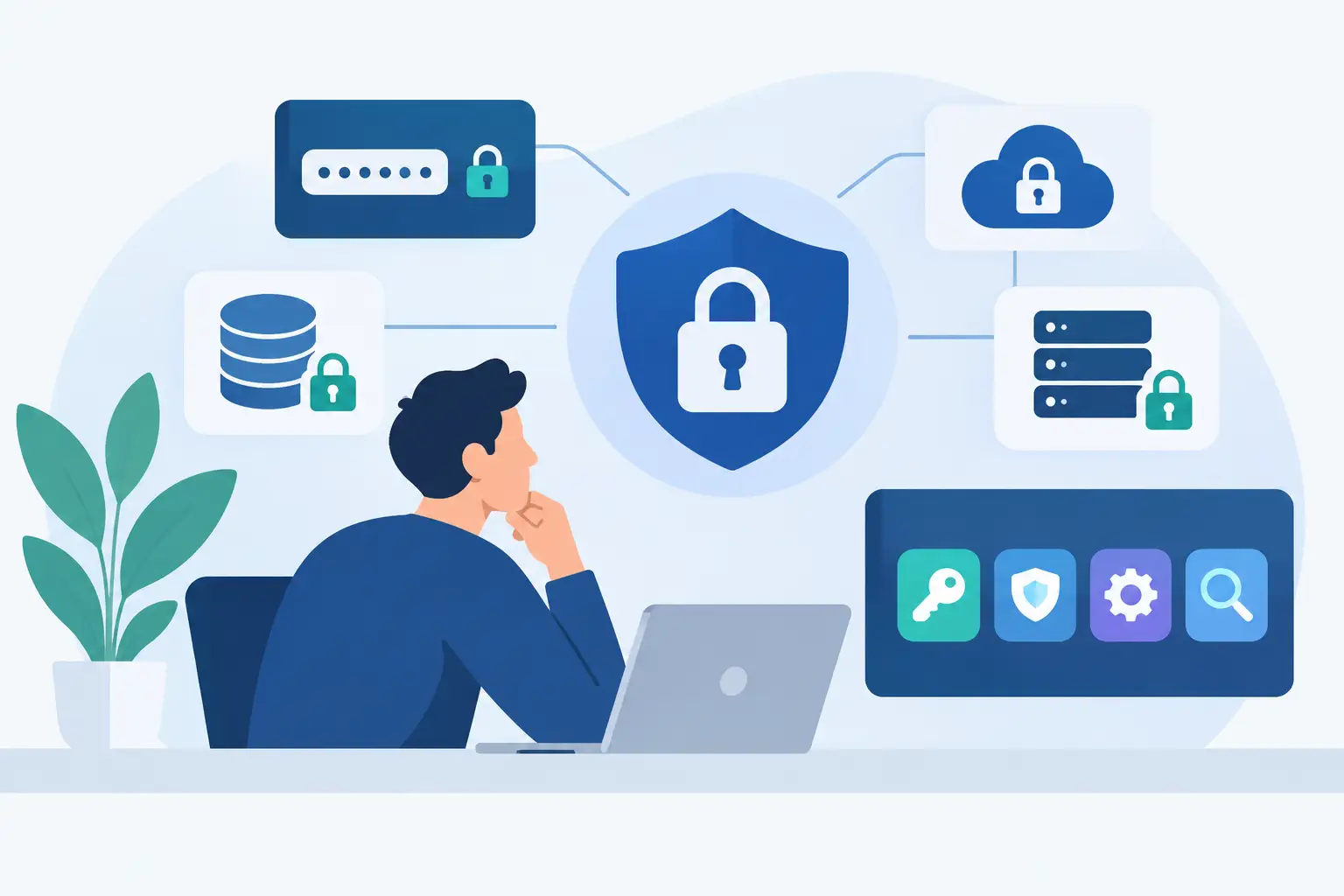
An exposed API key in a repository, a password shared via chat, or a certificate that expires without notice can halt critical operations. The selection of secret management tools should not be treated as an isolated cybersecurity purchase: it affects operational continuity, the software delivery cycle, and the ability to audit who accesses sensitive systems.
For an organization modernizing applications, migrating workloads to the cloud, or integrating automation, secrets cease to be a technical detail. Database credentials, tokens for external services, encryption keys, and certificates are involved in every deployment. If managed manually, the company accumulates risk, dependency on specific individuals, and avoidable support costs.
What a Secret Management Tool Should Solve
A secret manager centralizes the storage, access, and rotation of confidential information needed by applications, users, and automated processes. Its goal is not simply to hide a password. It must reduce data exposure while allowing teams to operate quickly and with traceability.
This implies clearly separating code from its credentials. A repository may contain the configuration needed to deploy an application, but it should not include permanent secrets. Similarly, a container image should not incorporate tokens that remain valid after its creation. The secret is retrieved at runtime, under a verifiable identity and with limited permissions.
The difference is relevant for management and operations. When credentials are scattered across configuration files, spreadsheets, CI/CD platforms, and personal accounts, a staff departure or an incident forces a slow and incomplete review. With a well-designed system, the team can revoke, replace, and audit access from a controlled point.
Criteria for Choosing Secret Management Tools
The right tool depends on the architecture, the maturity of the team, and regulatory obligations. Not all organizations need the same level of complexity. However, there are criteria worth evaluating before making a decision.
Identity Before Passwords
The first criterion is how the platform authenticates those requesting a secret. A mature solution should integrate with the corporate identity provider, cloud permissions, and workload identities. Identity-based access prevents a server or application from relying on a previously distributed static password.
It is also advisable to check that it supports least privilege policies. A billing process does not need to query the keys of all environments, and a developer should not have default access to production credentials. Authorizations should be definable by application, environment, team, and type of secret.
Rotation and Temporary Credentials
Storing secrets centrally is an improvement, but it does not eliminate risk if credentials remain valid for years. The ability for automated rotation deserves special attention. In certain cases, a tool can generate temporary credentials for a database or cloud service and revoke them when the task is complete.
Dynamic credentials reduce the impact of a leak because they have a limited lifespan. In return, they require more integration work and applications prepared to renew their access without interruptions. For legacy systems that only accept static users, it may be necessary to start with scheduled rotation and evolve later.
Integration with the Delivery Cycle
The tool must work with the actual way the company builds and deploys software. Its integration with continuous integration and delivery pipelines, container platforms, infrastructure as code managers, and execution environments should be reviewed. If the team has to manually copy values between systems, control will eventually degrade.
Good integration prevents secrets from appearing in build logs, persistent pipeline variables, or deployment artifacts. It also allows for a consistent policy to be applied across development, testing, and production, without turning every configuration change into a manual request to the infrastructure team.
Useful Auditing, Not Just Accumulated Logs
In an incident, knowing that a log exists is not enough. The organization needs to respond accurately to operational questions: who accessed a secret, from which identity, when, for which service, and whether a policy was modified. Therefore, events must be complete, immutable, and easy to correlate with the rest of the security monitoring.
This aspect has value beyond compliance. A well-structured audit accelerates the investigation of configuration errors, facilitates periodic privilege reviews, and prevents knowledge of critical access from being held by a single person.
Availability, Residency, and Operating Model
A secret manager becomes a central dependency. If it is unavailable, an application may not start, or a deployment may be blocked. It is necessary to analyze its guarantees of availability, disaster recovery, backups, and behavior in the event of a partial network failure.
The operating model also matters. A managed solution reduces administrative burden but may limit certain controls or condition the location of data. A self-managed solution offers greater customization capability, although it requires expertise to maintain encryption, updates, high availability, and recovery. The decision should respond to business requirements and internal capacity, not technological preferences.
Avoiding Two Common Mistakes
The first is treating the secret manager as a more sophisticated password repository. The real value emerges when identities, policies, automation, and rotation are connected. Migrating values to a new platform without redesigning permissions can retain the same excessive access that already existed.
The second is trying to migrate everything at once. In organizations with legacy applications, multiple cloud providers, and old operational scripts, a massive approach often generates disruptions. It is safer to identify the most critical secrets, eliminate those exposed in code or configurations, and establish a reusable pattern for new applications.
A Deployment Approach That Reduces Risk
The deployment should start with an inventory. Not just of passwords, but of all active secrets: API keys, certificates, automation tokens, database credentials, SSH keys, and secrets used by third-party integrations. Each item should have an owner, environment, level of criticality, and rotation date or policy.
Next, it is advisable to define a reference architecture. This establishes how applications authenticate, what mechanism each environment uses to retrieve values, and how responsibilities are separated between development, platform, and security. Without these decisions, the tool risks becoming another component with difficult-to-maintain exceptions.
The next phase should be a controlled pilot with a representative application. Ideally, one that uses CI/CD, managed services, and a database, as it allows for validating the complete journey. The goal is not just to demonstrate that the secret can be retrieved, but to verify revocation, rotation, audit logs, recovery, and operation under failure.
Once the pattern is validated, it can be extended across business domains and preventive controls can be established. Repository analyses can detect exposed credentials before they reach production. Infrastructure reviews can prevent configurations that inject secrets insecurely. And operational documentation should clarify how to request access, how to respond to an exposure, and who approves exceptions.
The Technological Decision Should Serve the Architecture
There is no single valid answer between a native cloud service, an independent platform, or a solution integrated into the development ecosystem. An environment focused on a single provider may benefit from native services and more direct identity management. A hybrid or multicloud company, on the other hand, may prioritize a common layer to avoid different rules on each platform.
The comparison should include the total cost of operation, not just the license or monthly consumption. Hours of administration, training, developer support, high availability needs, and integration effort with existing systems should be valued. An apparently economical option can be costly if it forces the maintenance of too many manual processes or if it does not fit the target architecture.
Secret management works best when it stops relying on individual discipline and becomes part of the system design. Turning that principle into policies, automation, and sustainable delivery practices protects operations without hindering the company's ability to change.