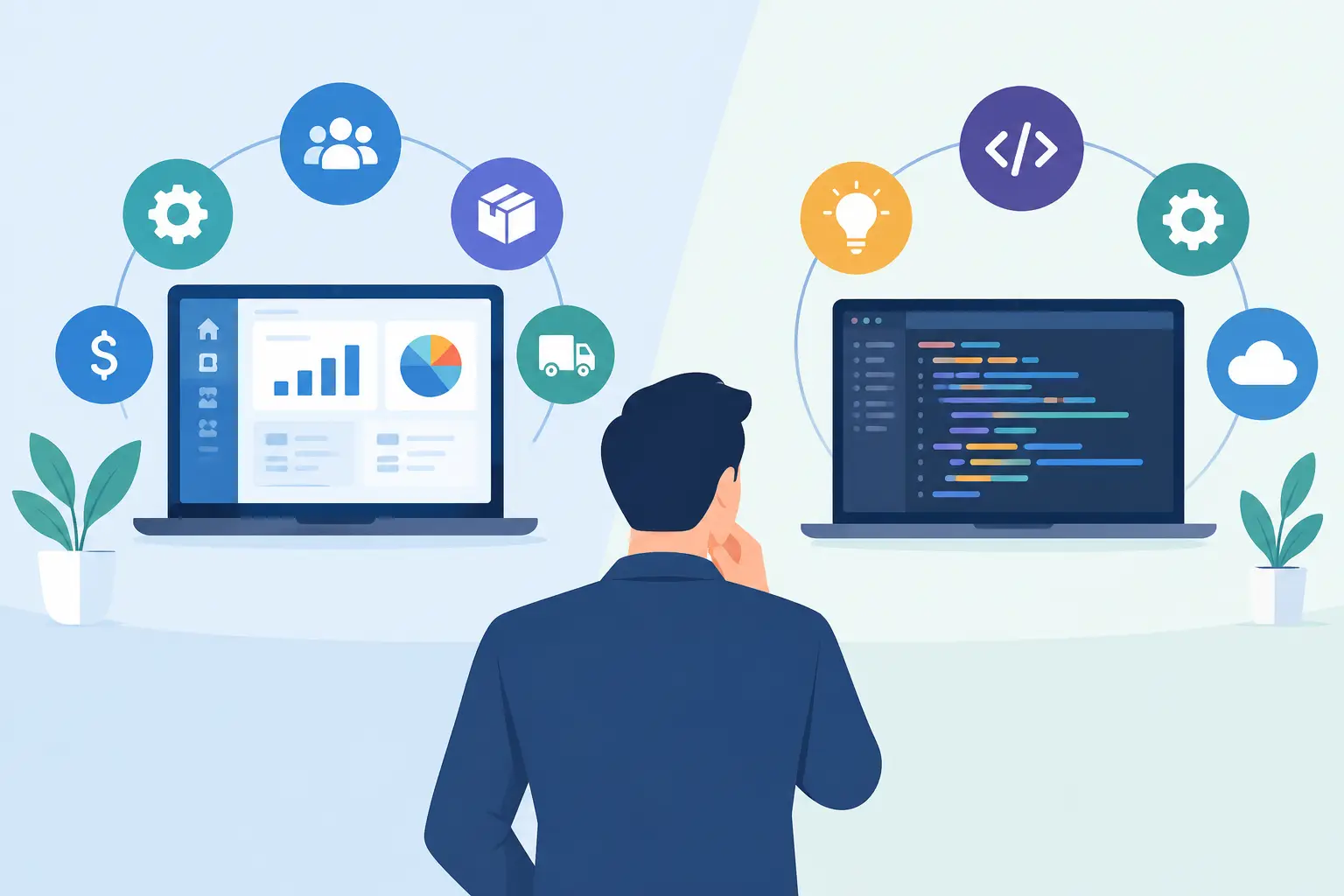
A company with critical operations usually does not have a problem with a lack of tools. The usual scenario is the opposite: parallel spreadsheets, isolated applications, manual processes, and data that arrives late to those who need to decide. In that context, choosing between ERP vs custom software is not purely a technological decision. It defines to what extent the operation will adapt to the system or the system will be designed around the operation.
An ERP can standardize entire areas within relatively predictable timelines. A custom solution can address processes that are differential, complex, or incompatible with a standard model. The right decision depends less on the popularity of a platform than on the nature of the processes, the quality of the data, and the cost of maintaining current limitations.
ERP vs Custom Software: The Essential Difference
An ERP is an integrated platform for managing recurring business functions: finance, purchasing, inventory, production, sales, human resources, or logistics. Its value lies in starting from known processes, a common data model, and already proven modules. The company configures the system, adjusts permissions, defines flows, and, when necessary, incorporates extensions.
Custom software is built for a specific need. It can be an operational application for field teams, a portal for customers, a planning engine, an integration layer between systems, or an internal platform that automates specific decisions. It does not aim to cover the entire company by default: it solves the defined problem.
This difference has a relevant consequence. With an ERP, the organization assumes part of the operational discipline proposed by the product. With custom development, the organization takes on the responsibility of precisely defining its rules, exceptions, data, and criteria for evolution. Neither option eliminates complexity; they place it in different locations.
When an ERP Adds More Value
An ERP is often a good choice when processes are common to the sector and the priority is to achieve consistency. Accounting, supplier management, procurement, inventory control, and billing rarely justify a rebuild from scratch if the company can operate with established practices.
It is also suitable when there is a clear need for traceability and data governance. A single system can reduce duplications, improve financial closures, and provide visibility over orders, inventory, or costs. But that result does not appear simply by activating modules. It requires cleaning master data, agreeing on responsibilities, and redesigning processes before transferring them to the system.
Standardization is an Advantage, but Not Always
Standardization reduces variability and facilitates training, audits, and reporting. However, it can become a restriction when the process being modeled is a real source of competitive advantage. If a sales team, a logistics operation, or a service methodology works differently because it generates better margins or a differential experience, forcing it into a generic flow can erode that value.
Deep customizations within an ERP deserve special caution. In the short term, they seem like a quick way to adapt the product. In the medium term, they can increase update costs, complicate support, and create dependencies that are difficult to document. If the adaptation alters the core of the platform, one must compare that risk with the alternative of building a well-integrated external application.
When Custom Software is Preferable
Custom software makes sense when the problem does not reasonably fit into a standard product or when integration between multiple tools has become the main bottleneck. This is common in companies with field operations, complex pricing models, approval processes with many exceptions, professional services with advanced planning, or industrial environments with legacy systems.
Its greatest advantage is that it can represent the operational reality without forcing the business to work around artificial limitations. It allows designing interfaces tailored to each profile, automating specific rules, and connecting data from multiple sources. When well-planned, it reduces manual work and improves the quality of information that reaches management.
However, custom development does not mean replicating a complete ERP. Trying to build mature accounting, payroll, or tax management functions from scratch usually increases risk without providing proportional differentiation. The most solid approach often focuses custom development on the processes that distinguish the company and maintains standard components where they provide stability.
The Challenge is Not Programming, but Sustaining the System
The initial investment is only part of the cost. A custom product needs a well-prepared architecture for evolution, automated testing, access control, observability, documentation, and a clear support model. It also requires that functional knowledge does not remain solely with a few individuals.
Therefore, before starting development, it is advisable to establish who will prioritize changes, how adoption will be measured, and what indicators will determine if the solution is improving operations. Software that automates a deficient process can execute errors more quickly. The diagnostic phase is as important as the construction.
Cost, Timeline, and Risk: Compare the Complete Cycle
Comparing ERP licenses with development hours offers an incomplete view. The total cost must include implementation, data migration, integrations, training, support, security, updates, and the operational impact during the change. In both cases, the project can fail if the effort of adoption is underestimated.
An ERP usually has a shorter startup timeline when processes are close to its standard model. However, implementations can be prolonged if each department tries to retain all its historical flows. Custom software may take longer in its initial phases, but it allows for incremental delivery: starting with the most costly bottleneck and expanding capabilities with evidence of real use.
The technical risk is also different. In an ERP, the risk concentrates on configuration, the quality of integrations, and vendor dependency. In a custom solution, it concentrates on scope, architecture, and the ability to maintain the product. The question is not which has less risk in the abstract, but which risk the organization can manage better.
A Practical Framework for Decision Making
Before selecting a platform or commissioning development, it is advisable to classify processes according to their impact and variability. Four questions help separate standard needs from capabilities that justify specific investment:
- Does this process really differentiate us from our competitors, or is it a common administrative function?
- How many legitimate exceptions does it require, and what cost do those exceptions generate today?
- What systems, teams, and data sources must be involved to complete it?
- What will happen when volume, users, regions, or compliance requirements increase?
The answers should be supported by data. Measuring manual hours, errors, cycle times, rework costs, billing delays, or lost opportunities allows for a more rigorous assessment of return. It also prevents building functions based solely on individual preferences.
It is useful to create an architecture map before choosing. It should show which system will be the main record for each type of data, how information will travel between applications, where business rules will be applied, and who will manage each integration. Without this design, it is easy to create an ecosystem where multiple systems claim to be the source of truth.
The Hybrid Approach is Often the Most Realistic
The choice is not always binary. Many organizations achieve better results by using an ERP as a transactional core and building specific applications around it. The ERP manages finance, purchasing, or inventory; custom software addresses customer experience, specialized operations, decision automation, or integration with legacy systems.
This model requires clear boundaries. Peripheral applications should not unnecessarily duplicate financial logic or create independent copies of master data. Integrations must be designed with contracts, monitoring, error management, and recovery criteria. An improvised connection may work initially and later become a silent source of operational issues.
For StrateCode, mature decision-making starts with architecture and business outcomes, not with the tool. An early technical and operational analysis allows identifying what should be standardized, what deserves to be built, and what processes should be eliminated before digitizing them.
The best choice will be the one that allows the company to operate with more control without compromising its ability to adapt. If a process is standard, it is advisable to leverage mature software. If it concentrates knowledge, margin, or customer experience, it deserves a solution designed to evolve with the business.