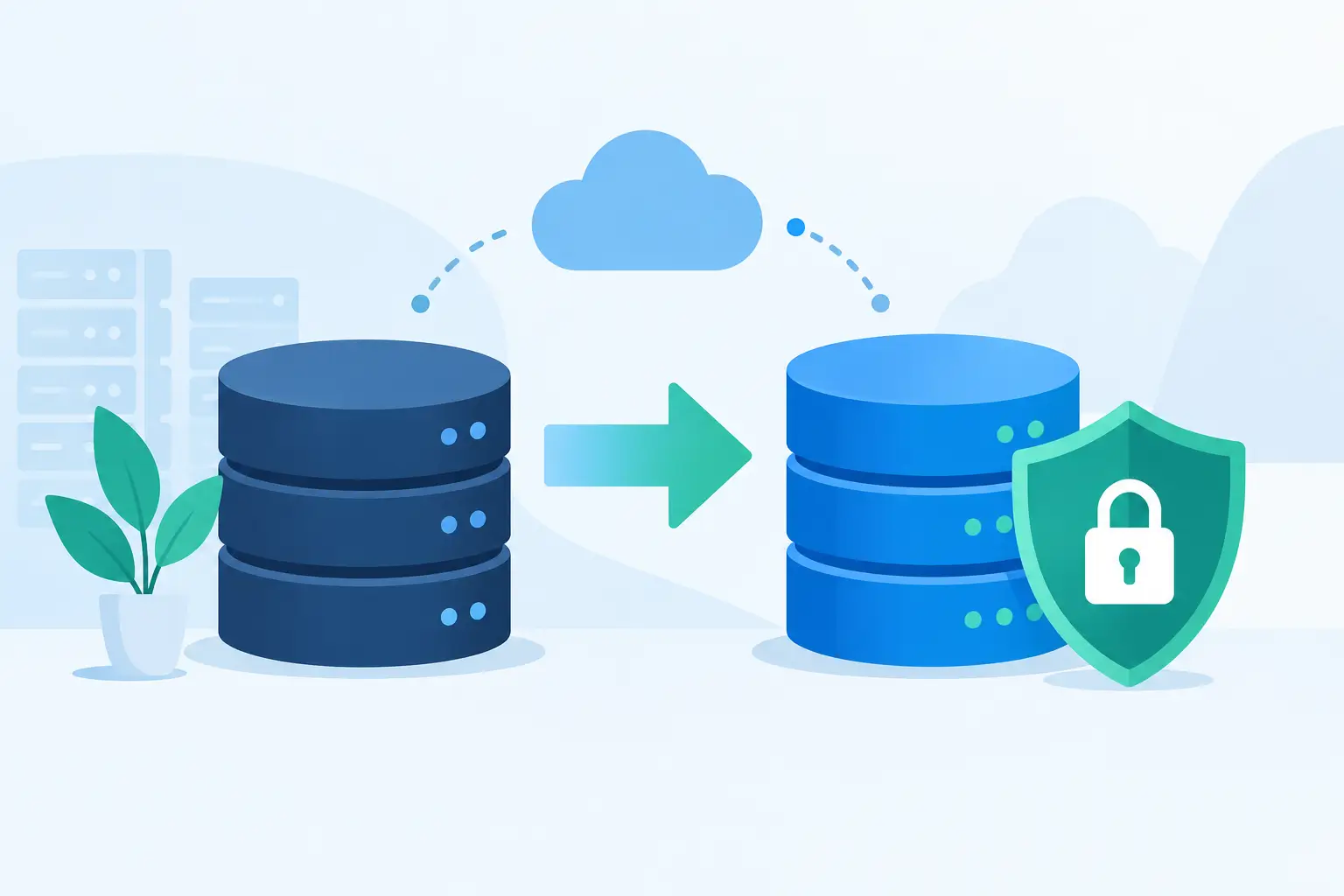
A failed migration is rarely explained by a single technical error. It is usually the result of misclassified data, undocumented dependencies, unrealistic cutover windows, or insufficient validations. This database migration guide addresses the work as it should be approached in business environments: an intervention on a critical system, with measurable objectives, risk controls, and a clear rollback strategy.
Migrating a database can respond to very different reasons: retiring legacy infrastructure, moving to the cloud, reducing licensing costs, improving performance, consolidating platforms, or enabling new analytical capabilities. The destination may be technically better, but the value depends on the transition preserving the integrity of the information and not compromising operations.
What a database migration should resolve
The goal is not to move tables from one server to another. It is to ensure that applications, processes, users, and integrations continue to function with complete, consistent, available, and protected data. For a business manager, this translates into operational continuity, compliance, and reduced financial exposure. For the technical team, it involves controlling schemas, transactions, performance, permissions, latency, and recovery mechanisms.
It is advisable to establish from the outset what result is expected. If the priority is to reduce the downtime window, the architecture should favor replication and incremental synchronization. If the goal is to modernize an obsolete platform, it will likely be necessary to review data types, stored procedures, business rules, and access patterns. Attempting both approaches without clearly defining the scope usually increases risk and prolongs the project.
It is also important to distinguish between a homogeneous migration and a heterogeneous one. In the former, the environment is changed while maintaining the same engine, for example, from a local instance of PostgreSQL to a managed service. In the latter, technology is changed, such as moving from Oracle to PostgreSQL. Homogeneous migration reduces incompatibilities, although it does not eliminate configuration, security, or performance issues. Heterogeneous migration requires deeper analysis and much broader functional testing.
Phase 1: Assess the current state before moving data
Planning begins with a reliable inventory. It is not enough to know the size of the main database. All affected sources must be identified, including replicas, document stores, exchange files, reporting systems, queues, caches, and third-party services that consume or write information.
The analysis must answer specific operational questions: which applications depend on each dataset, which processes are most critical, what is the growth volume, what information is subject to regulatory requirements, and how long each service can be unavailable. The response should not remain in theoretical documents. It must be validated with process owners and with the teams that maintain the applications.
In this phase, it is common to discover that part of the business logic resides in the database itself. Stored procedures, triggers, complex views, and scheduled jobs may contain rules that no one has documented outside the original engine. Ignoring them may allow an apparently correct initial load and yet cause errors in billing, reconciliation, inventory, or customer service days after the change.
It is useful to establish a performance baseline before migration. Record response times for critical queries, transaction rates, CPU load, storage consumption, locks, and recurring errors. Without this data, it will be difficult to demonstrate whether the new platform improves the situation or introduces degradations that must be corrected before opening it to the entire user base.
Phase 2: Design the migration strategy
There is no universally correct method. The choice depends on volume, tolerance for disruption, complexity of transformation, and the team's ability to operate both environments during a transition period.
A migration with a scheduled downtime may be reasonable for an internal application with low criticality, a limited dataset, or a maintenance window accepted by the business. It is simpler to control because writes are stopped, the copy is made, validated, and traffic is redirected. Its limitation is evident: the organization assumes unavailability.
When operations cannot tolerate significant downtime, an initial load strategy followed by change replication is usually preferable. The new environment is fed with a base copy and receives modifications produced at the source until the cutover moment. This approach reduces unavailability but adds complexity: conflicts must be managed, replication lag checked, and confirmation that all changes arrive in the correct order.
Modernization may also require a phased migration. Instead of moving the entire system at once, functional domains or specific services are separated. This option limits the impact of each deployment and facilitates learning, but requires well-defined interfaces and strict governance of shared data. Maintaining two sources of truth for too long generates inconsistencies and operational costs.
Define success and rollback criteria
Before executing, the project must have verifiable acceptance criteria. For example, a defined percentage of record reconciliation, maximum response times for critical operations, absence of integrity errors, and confirmation that backups can be restored. Saying that "the data looks good" is not a sufficient criterion.
Similarly, the rollback plan must be executable, not just a note at the end of the documentation. It should specify who makes the decision to revert, what conditions trigger it, how writes made during the cutover are preserved, and how long the previous environment will remain available. A rollback that has not been rehearsed has little value when pressure increases.
Phase 3: Prepare data, security, and automation
The quality of the data determines much of the effort. Duplicates, inconsistent formats, broken references, and invalid historical values do not disappear when changing platforms. Migration can be an opportunity to correct them, but each transformation must be approved by the corresponding functional owner. The technical team should not infer on their own which record is valid when the decision affects customers, contracts, or financial transactions.
This is also the time to apply security principles from the design phase. Data must be encrypted in transit and at rest, and access to test environments should be limited according to the sensitivity of the information. When using production data to validate processes, anonymization or pseudonymization may be necessary. Temporary credentials, integration secrets, and service account permissions should be reviewed before the change, not after detecting unauthorized access.
Automation reduces manual errors and provides traceability. Extraction, transformation, loading, and validation scripts must be versioned, reviewed, and able to be executed again in a controlled environment. The same applies to infrastructure: configuring networks, storage, users, and policies through repeatable processes avoids difficult-to-diagnose differences between pre-production and production.
Phase 4: Test as if the cutover has already occurred
Isolated technical tests are not enough. A migration must be validated at multiple levels: structure, volume, referential integrity, application behavior, performance under load, and backup and recovery operations. If the system supports high-impact processes, tests must reproduce scenarios close to reality, including traffic spikes and concurrent operations.
Data reconciliation deserves specific treatment. Comparing the total number of rows is an initial signal, but does not demonstrate accuracy. Keys, business aggregates, amounts, record statuses, and relevant relationships must be contrasted. In very large datasets, checks can be based on hashes, partitions, and targeted sampling, as long as the method is documented and sufficient for the assumed risk.
The dress rehearsal must include the complete sequence: final freeze or synchronization, configuration change, validations, communication to users, and decision to open. This exercise reveals dependencies that diagrams do not show, such as a nightly task, an expired certificate, or an integration still pointing to the old server.
Phase 5: Execute the cutover and stabilize operations
During the cutover, discipline is more valuable than speed. There must be a coordination lead, a defined communication channel, and a list of decisions with assigned responsibilities. Application, infrastructure, security, and business teams need a common view of the status, milestones achieved, and any deviations.
After activating the new environment, observability is a priority. Monitor application errors, latency, resource saturation, authentication failures, replication delays, and the evolution of the most costly queries. The first few days often reveal usage patterns that did not appear in tests, especially when real users interact with less frequent functions.
Do not immediately remove the previous environment. Keeping it in controlled mode for an agreed period facilitates incident investigation and provides a safety net. However, prolonging this coexistence without a closure date increases costs and the risk that someone accidentally reuses the old system.
The database migration guide must conclude with operations
The project does not conclude upon completing the last record. It must close with updated documentation, knowledge transfer, cost review, verified backup policies, and an incident evaluation. It is also advisable to record which assumptions were correct and which were not, as this learning reduces the risk of the next modernization.
A successfully migrated database is not just a database that starts on another infrastructure. It is an asset that can be operated, protected, scaled, and evolved without relying on improvisations. That difference is what turns a technical intervention into a sustainable improvement for the business.