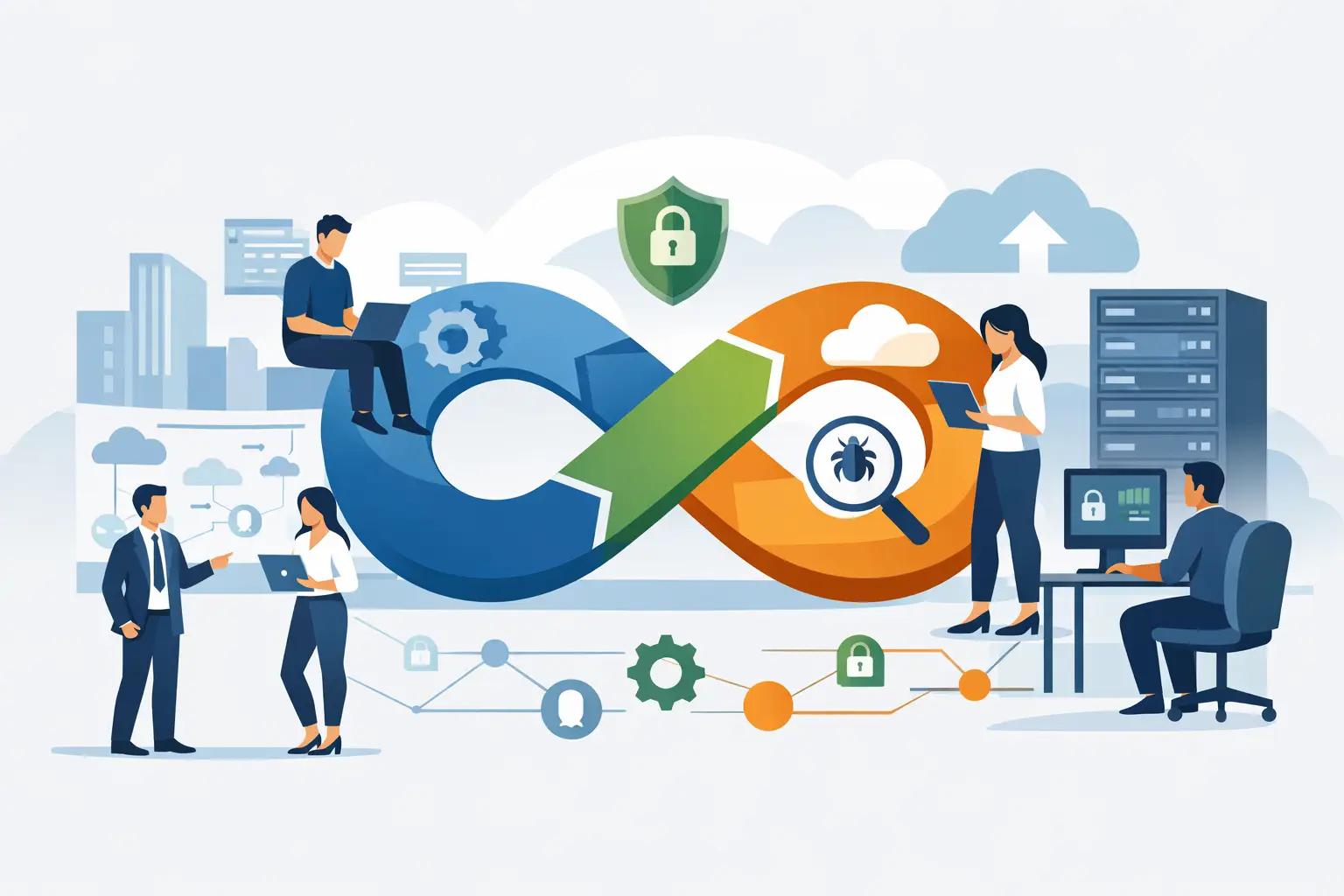
A vulnerability detected days before a production deployment is not just a security issue. It can delay revenue, block a critical migration, consume team capacity, and deteriorate trust between engineering and business. A guide for enterprise adoption of DevSecOps must start from this reality: integrating security into software delivery is not about adding more controls, but about redesigning how technical decisions are made, risks are prioritized, and changes are validated.
DevSecOps works when security stops being a final gate and becomes a distributed, automated, and governed capability. To achieve this, the organization needs to combine architecture, processes, tools, and clear responsibilities. Automation is necessary, but it does not compensate for a weak strategy or a poorly designed platform.
What Enterprise Adoption of DevSecOps Must Address
The goal is not to implement all available tools or turn every delivery into an endless approval process. It is to reduce material risk without losing delivery speed. In a company with legacy systems, distributed teams, or regulatory requirements, this demands prioritization with more rigor than in a small, homogeneous product environment.
The adoption must answer four business questions. What assets, data, and processes cannot fail? What risks are acceptable and which require blocking? Who makes the decision when an exception arises? How will it be demonstrated that the controls improve the situation?
Without these answers, teams often fall into two extremes. The first is reactive security: it is reviewed late, corrected under pressure, and exceptions accumulate without traceability. The second is excessive control: pipelines are filled with alerts, manual approvals slow down delivery, and developers seek shortcuts. Neither reduces risk sustainably.
Phased Guide to Enterprise Adoption of DevSecOps
A useful implementation does not start by purchasing a code analysis platform. It begins by understanding the current delivery flow, the dependencies that condition it, and the actual exposure of each system. The sequence can be adapted to the size of the company, but it is advisable to progress in four phases.
1. Establish a Baseline of Risk and Delivery
Map the complete cycle from code change to production. Identify repositories, external dependencies, credentials, environments, approval processes, infrastructure as code, and rollback mechanisms. The purpose is to locate where risks are introduced and where they are detected too late.
This assessment should also collect operational indicators: deployment frequency, cycle time, rate of failed changes, recovery time, and volume of security incidents. This is not about creating a decorative dashboard. The baseline allows checking, months later, if DevSecOps has reduced exposure and friction or simply shifted work from one team to another.
In legacy systems, inventory is often the most challenging part. There may be applications without a clear owner, obsolete libraries, shared service accounts, or manual configurations that are undocumented. Trying to fix everything at once paralyzes the program. It is preferable to classify systems by criticality, exposure, and change capacity.
2. Define Controls Proportional to Risk
Not all applications need the same level of control or the same review cadence. A service that processes payments, personal data, or strategic information requires stricter policies than an internal tool without access to sensitive data. Proportionality prevents the security model from being perceived as undifferentiated bureaucracy.
The initial controls should cover, at a minimum, dependency analysis, secret detection, static code analysis, infrastructure as code review, and container image analysis when used. There should also be rules for vulnerability management: severity, correction deadline, exception criteria, and risk acceptance responsibility.
Automatic blocking should be applied judiciously. Stopping a build due to an exposed credential or a critical exploitable vulnerability is usually justified. Blocking every low-relevance alert can lead to fatigue and reduce the system's credibility. The correct policy depends on the service's criticality, whether there is known exploitation, compensatory controls, and the realistic correction window.
3. Integrate Security into the Delivery Platform
Security must be incorporated into the flows that teams already use: repositories, change reviews, continuous integration pipelines, infrastructure provisioning, and observability in production. If controls exist in a separate tool and require manual steps, they will end up being applied irregularly.
A well-designed engineering platform offers reusable components. For example, pipeline templates with preconfigured analysis, approved infrastructure modules, centralized secret management, artifact logs with signing policies, and ephemeral environments for testing. This reduces variability between teams and prevents each project from solving the same problems from scratch.
It is important to distinguish between standardization and rigid uniformity. A team maintaining a monolithic application in a data center will not have the same flow as another operating cloud services. Both can adhere to the same principles - traceability, protected secrets, controlled dependencies, and auditable deployments - with different implementations.
4. Operate, Measure, and Improve Without Turning It into an Isolated Project
DevSecOps does not end when a set of scanners is activated. The organization needs to review findings, reduce security debt, adjust rules, and learn from incidents and deployment failures. The quality of this operation determines whether the investment generates risk reduction or a growing queue of ignored alerts.
Measure both coverage and results. Coverage indicates what percentage of repositories, pipelines, and assets have active controls. Results show whether those controls are working: critical vulnerabilities open past deadlines, secrets detected before production, percentage of deployments with traceable artifacts, mean time to correction, and recurrence of findings.
It is also useful to relate security and reliability. If the number of failed changes increases after implementing a new policy, the problem may lie in a poorly calibrated rule, a bad development experience, or unplanned technical debt. The data should open a conversation for improvement, not be used to penalize teams.
The Operating Model That Avoids Friction Between Teams
Technology does not replace the model of responsibilities. Security defines policies, risk criteria, and monitoring capabilities. Engineering integrates controls into the platform and maintains the development experience. Product or application teams are responsible for fixing vulnerabilities and keeping their services within agreed standards. Management must resolve priorities and explicitly accept risks that cannot be eliminated on time.
This division avoids two common mistakes. The first is turning the security team into the owner of all fixes, which is unfeasible at scale. The second is completely delegating security to development teams without providing them with patterns, training, or incident response capabilities.
The so-called security champions can help, especially in organizations with multiple engineering teams. However, they should not be used as substitutes for a security team or a common platform. Their value lies in accelerating communication, conveying technical context, and detecting adoption issues before they escalate.
Errors That Increase the Cost of Transformation
The most common mistake is starting with the tool and measuring success by the number of activated integrations. A tool can detect thousands of problems that no one has the capacity to resolve. The priority should be to build a triage process: confirm relevance, assign an owner, set a deadline, and verify closure.
Another mistake is treating exceptions as emails or informal agreements. Each exception must have scope, justification, compensatory controls, a responsible party who accepts the risk, and a review date. This way, the exception stops becoming invisible debt.
Finally, it is not advisable to impose a massive transformation without representative pilots. Choose a critical but manageable service, with a team willing to collaborate and a reasonably stable delivery flow. That pilot allows calibrating rules, demonstrating impact, and creating reusable patterns before extending the model.
For organizations that need to combine assessment, platform design, and implementation, a partner with architectural and execution capabilities like StrateCode can reduce the risk of the program remaining as recommendations without operational adoption.
The best sign of maturity is not a pipeline with more controls, but an organization capable of delivering changes with clear evidence of what has been validated, what risk remains, and who has made each decision. That level of discipline turns security into a property of the delivery system, not a last-minute intervention.