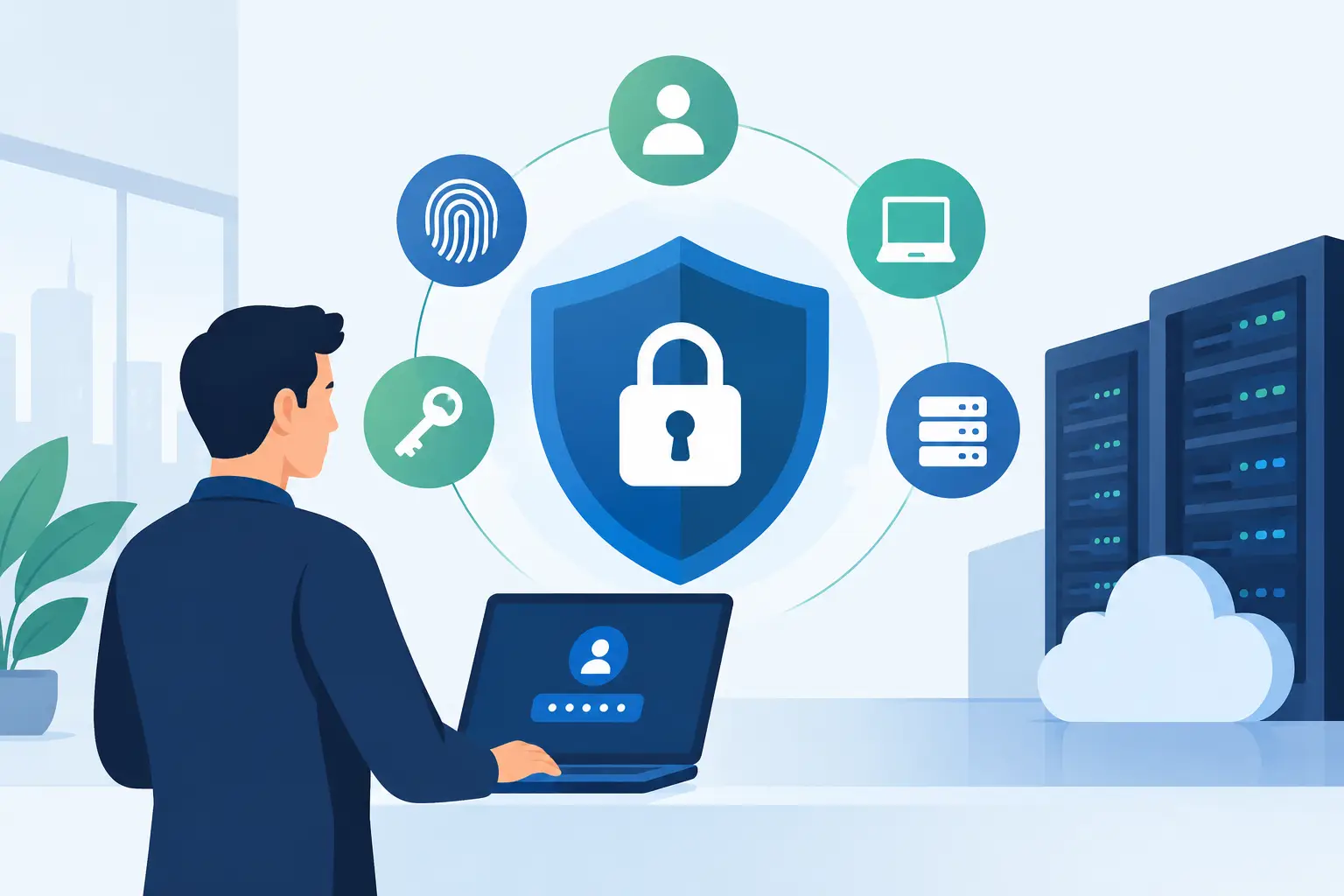
An unattended administrator account can compromise a cloud platform, halt a business line, or expose regulated data in minutes. Therefore, selecting the best privileged access controls is not just about buying a password tool: it requires designing a security operating system that limits who can act, what they can do, for how long, and with what evidence.
For a CIO, CTO, or operations manager, the problem often arises as infrastructure grows. Local accounts multiply, vendors need remote access, support teams share emergency credentials, and historical privileges survive job changes. The risk does not only come from an external attacker. It also arises from operational errors, excessive permissions, and lack of traceability during an incident.
What a Privileged Access Program Should Control
Privileged access encompasses any identity that can modify configurations, deploy code, manage databases, create users, access secrets, or alter security controls. It includes human administrators, service accounts, application identities, CI/CD pipelines, and third-party access.
The goal is not to eliminate administrative capability. It is to reduce permanent privilege and make every sensitive action verifiable. An effective program accurately answers four questions: who requested access, why they needed it, what they did during the session, and when that permission was revoked.
The difference is significant because many organizations apply multi-factor authentication and believe they have solved the problem. MFA protects the login, but it does not prevent a legitimate administrator from retaining unnecessary permissions nor does it sufficiently log a destructive operation. It is a necessary layer, not a complete privilege control.
The Best Privileged Access Controls: Selection Criteria
There is no optimal platform for all companies. An organization with legacy infrastructure, on-premises data centers, and external vendors will have different priorities than a cloud-native company that delivers software multiple times a day. Still, the following controls form the foundation of a mature architecture.
Centralized Credential and Secret Management
Administrative passwords, SSH keys, API tokens, certificates, and automation secrets should not reside in spreadsheets, personal managers, or exposed variables in scripts. A central repository allows for storing these encrypted assets, assigning policies, and rotating them without relying on manual processes.
Automatic rotation is especially valuable for shared accounts and service accounts. If a credential is leaked, its limited lifespan reduces the exposure window. However, automating it without inventory or testing can break critical integrations. Before activating aggressive policies, it is advisable to identify dependencies and define a rollback process.
Least Privilege and Just-in-Time Access
The principle of least privilege states that each identity should have only the essential permissions. Just-in-time access goes a step further: it grants elevated privileges for a limited time and for a specific task, rather than keeping them active permanently.
This approach drastically reduces the attack surface. An engineer can receive production permissions to investigate an incident for two hours and automatically lose them upon completion. For sensitive functions, the request should include the reason, affected system, duration, and, when the risk justifies it, approval from the corresponding manager.
Balance is key. A slow approval flow pushes teams to seek shortcuts, especially during a service disruption. The best designs differentiate between ordinary access, planned changes, and emergency access. The latter should be quick but subject to mandatory post-review.
Enhanced Authentication and Conditional Access
Phishing-resistant MFA should protect all administrative routes, including VPNs, cloud consoles, support tools, and legacy systems when technically possible. Key-based security factors or cryptographic authentication offer superior protection to SMS codes against session theft and social engineering.
Conditional access adds context: device status, unusual location, identity risk level, source network, and resource sensitivity. It is not about indiscriminately blocking those working outside the office, but about elevating checks when risk conditions change.
Management and Recording of Privileged Sessions
A privileged session must pass through a checkpoint capable of recording commands, file transfers, and activity in critical systems. Recording is not intended to monitor staff by default. Its value lies in reconstructing incidents, facilitating audits, and speeding up the analysis of unauthorized changes.
It also allows for active controls. For example, dangerous commands can be blocked, copying data to unauthorized destinations can be prevented, or a second validation can be required before performing an irreversible action. The scope should be defined with proportionality criteria and a clear evidence retention policy.
Continuous Permission Review and Segregation of Duties
Privileges accumulate quickly. An employee changes teams, temporarily participates in a project, and retains access they no longer need. Periodic access reviews allow technical and business managers to confirm that each permission remains valid.
Segregation of duties prevents a single person from initiating, approving, and executing critical operations without independent control. In financial, healthcare, or regulatory environments, this principle reduces both fraud and errors. In smaller companies, it can be applied pragmatically: cross-review for production changes, approvals for emergency access, and separation between development and identity management.
The Common Mistake: Treating PAM as an Isolated Project
Privileged access management, or PAM, fails when implemented as a password vault without integrating it with identity architecture, device management, SIEM, change processes, and deployment automation. The result is often a tool with low adoption and numerous exceptions.
The program should start with a realistic inventory. It is necessary to locate administrative accounts, shared accounts, secrets embedded in code, vendor access, non-human identities, and emergency mechanisms. This phase often reveals that service accounts and pipelines have more privileges and less oversight than human users.
Next, it is advisable to classify assets according to operational impact. Not all require the same level of friction. A testing environment can use more agile controls than a customer database or a production console. This classification allows for investment where the risk is highest and prevents security from slowing down low-impact activities.
How to Implement Controls Without Blocking Operations
Implementation should be gradual and measurable. Starting with domain accounts, cloud administrators, third-party remote access, and systems containing sensitive data generates immediate improvement. Next, the model can be extended to data platforms, DevOps tools, and automation accounts.
It is advisable to define indicators from the outset: number of permanent privileged accounts, percentage of rotated secrets, active third-party accesses, recorded sessions, time to revoke permissions, and open exceptions. This data turns the program into a verifiable risk reduction initiative, not an abstract policy.
The experience of the teams should be part of the design. If developers need temporary permissions to resolve incidents, the flow should be simple, auditable, and compatible with their tools. If administrators manage legacy systems, it may be necessary to incorporate compensatory controls while modernizing authentication mechanisms. Maturity does not consist of imposing an ideal model all at once, but in first closing the most serious risks without jeopardizing service continuity.
Deciding with an Architectural Vision
When evaluating solutions, prioritize compatibility with your identity directories, cloud environments, operating systems, automation tools, and existing monitoring mechanisms. Also, assess the ability to manage non-human identities, apply just-in-time access, record sessions, and generate useful evidence for audits.
The tool matters, but architecture and operational discipline matter more. An advanced solution will not compensate for poorly defined roles, unknown assets, or permanent exception processes. In contrast, a consistent privilege design, supported by automation and integration, reduces operational risk and ensures that security keeps pace with business growth.
The next useful step is not to choose a platform based on its feature list, but to identify which privileges could halt your operation tomorrow and demonstrate that each one is under control.