An operations team needs to digitize a process that is spread across spreadsheets, emails, and manual approvals. The request seems simple: an internal application ready in a few weeks. However, the decision between low code vs development determines much more than the delivery date. It affects data quality, security, the ability to integrate critical systems, and the cost of maintaining the solution when the process changes.
Low code can be an effective response to limited and urgent needs. Custom development is often the necessary foundation when the application becomes part of the core operation. The right choice does not depend on following a trend, but on understanding the strategic value of the process, its technical constraints, and its expected evolution.
Low code vs development: the real difference
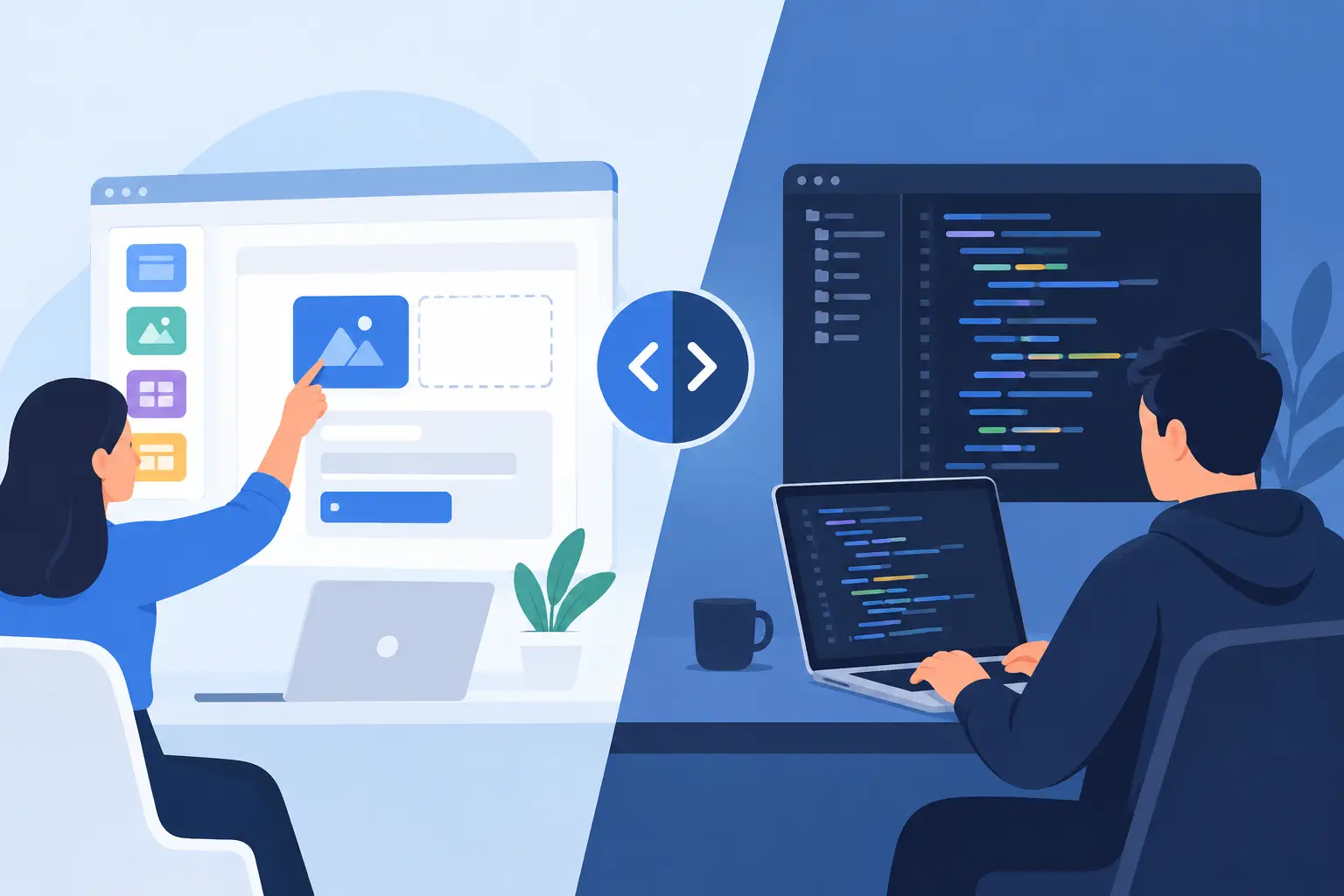
Low code platforms allow building applications using visual components, configurations, and predefined workflows. They reduce the amount of code needed and bring tool creation closer to business profiles or teams with limited technical capability. They are especially useful for forms, approval circuits, internal portals, simple dashboards, and automations with known rules.
Custom development takes a different approach. An engineering team designs the solution around business needs, existing systems, performance requirements, and security policies. It does not mean writing everything from scratch: a mature architecture leverages cloud services, established libraries, APIs, and specialized tools. The difference is that the organization retains much greater control over how the system behaves, integrates, and evolves.
Therefore, comparing both options solely based on initial build time leads to incomplete conclusions. An application may be available in fifteen days with low code, but require costly redesigns if it needs to handle complex rules, large volumes of data, or unforeseen integrations. Similarly, developing a temporary and very simple tool custom may be a disproportionate investment.
Initial speed does not always equate to business speed
The main argument in favor of low code is legitimate: it allows delivering value quickly. When a process is well-defined, data comes from accessible sources, and the solution has a contained scope, visual configuration eliminates repetitive work. It also makes it easier for business leaders to validate screens and workflows before the project drags on for months.
The problem arises when prototype speed is confused with sustainable speed. A commercial management application may start as a form with notifications and end up needing pricing rules, territory permissions, ERP synchronization, change traceability, and real-time data analysis. Each added exception can increase dependence on difficult-to-test, document, and maintain configurations.
In those cases, custom development may take longer at first, but it reduces friction in subsequent phases. A well-thought-out architecture separates business logic, integrations, and the interface. This allows modifying one part without compromising the whole, automating tests, and deploying changes in a controlled manner. For processes that evolve frequently, that capability has a direct impact on operational speed.
The question worth asking
It is not enough to ask: "How long will it take to launch it?" The more useful question is: "How long will it take to adapt this solution in a year, without increasing risk or halting operations?"
If the application will have a short life or covers a peripheral need, the answer may favor low code. If it will support business decisions, logistics, customer service, billing, or regulatory compliance, maintainability must weigh as much as the initial delivery.
Architecture, integration, and operational control
Companies rarely start from scratch. They coexist with CRMs, ERPs, support tools, data warehouses, legacy applications, and external providers. The value of a new solution depends on how it connects with that ecosystem, not just on what it displays on the screen.
Low code platforms often offer connectors for common services. This accelerates standard integrations, but does not guarantee that they cover the particularities of a business environment. APIs with specific limits, complex data models, custom authentication, legacy systems, or real-time synchronization requirements may require additional development. Sometimes, that development is done outside the platform itself, creating a hybrid architecture that needs clear governance.
With custom development, integrations are designed according to the criticality and behavior of each system. Queues can be defined to process events, retry mechanisms, auditing, error management, and access controls tailored to each case. It is a greater effort, but it is essential when a synchronization failure affects orders, inventory, payments, or sensitive data.
There is also a question of technological dependency. In low code, part of the business logic is tied to the platform's model, its licensing, and its export limits. This is not necessarily a disadvantage, as long as it is accepted consciously and the provider's stability is evaluated. For a differential capability or a critical system, it is worth assessing whether that dependency fits with the company's technological strategy.
Cost: looking beyond the license and the project
Low code often reduces the entry cost because it decreases the hours needed to build a first version. However, the license per user, per application, per execution, or per capacity can grow significantly when the solution expands. This is compounded by training, governance, specialized support, and possible add-ons to cover platform limitations.
Custom development requires a more visible initial investment. It requires analysis, architecture design, implementation, testing, deployment, and observability. But it offers greater freedom to optimize infrastructure, avoid functionalities that do not add value, and adapt spending to the actual use of the system.
The appropriate comparison is the total cost of ownership over three to five years. It should include licenses, infrastructure, functional evolution, support, security, training, vendor dependency, and the cost of a possible migration. It should also consider the opportunity cost: a cheap application that forces maintaining manual processes or generates errors can end up being much more expensive than a well-designed solution.
How to decide on the right approach
The decision does not have to be binary. Many organizations achieve good results with a combined model: low code for controlled departmental automations and custom development for core services, complex integrations, and digital products that are part of their value proposition.
Before choosing, it is advisable to classify the process according to its operational impact. If an interruption affects revenue, compliance, customers, or critical decisions, it should be treated as a strategic technological asset. In that scenario, architecture, testing, monitoring, and security are not extras of the project: they are starting requirements.
It is also important to measure the real complexity, not the apparent one. The following signals often justify a custom engineering approach:
- The solution needs to connect with several internal or external systems with specific synchronization rules.
- Permissions, audits, or data protection are subject to strict requirements.
- The volume of users, transactions, or information will grow significantly.
- The business logic is differential and changes frequently.
- The continuity of service has relevant operational or financial consequences.
Conversely, low code fits well when the flow is stable, the impact of a failure is limited, integrations are standard, and the team can operate the tool with a defined governance structure. That last condition is especially important. Allowing freedom to create applications without security criteria, functional ownership, data control, and lifecycle management can multiply what is known as shadow IT.
Technical governance to avoid fragile solutions
Both in low code and traditional development, a business solution needs clear responsibilities. There must be a definition of who manages access, who approves changes, where the information resides, how the service is recovered, and what indicators allow detecting failures before they affect the business.
In low code environments, governance should establish templates, naming standards, separate environments for development and production, connector reviews, and publication policies. In custom development, the focus expands to code reviews, test automation, continuous integration, secret management, and infrastructure observability.
The goal is not to bureaucratize delivery. It is to allow the organization to move quickly without building technical debt that limits the next project. Useful speed is the one that keeps the capacity for change under control.
The best decision does not stem from a preference for a tool, but from an honest reading of the process that needs improvement. If the problem is temporary and contained, simplifying makes sense. If the solution is going to support a significant part of the operation, it deserves an architecture capable of accompanying the company's growth, even when needs change.