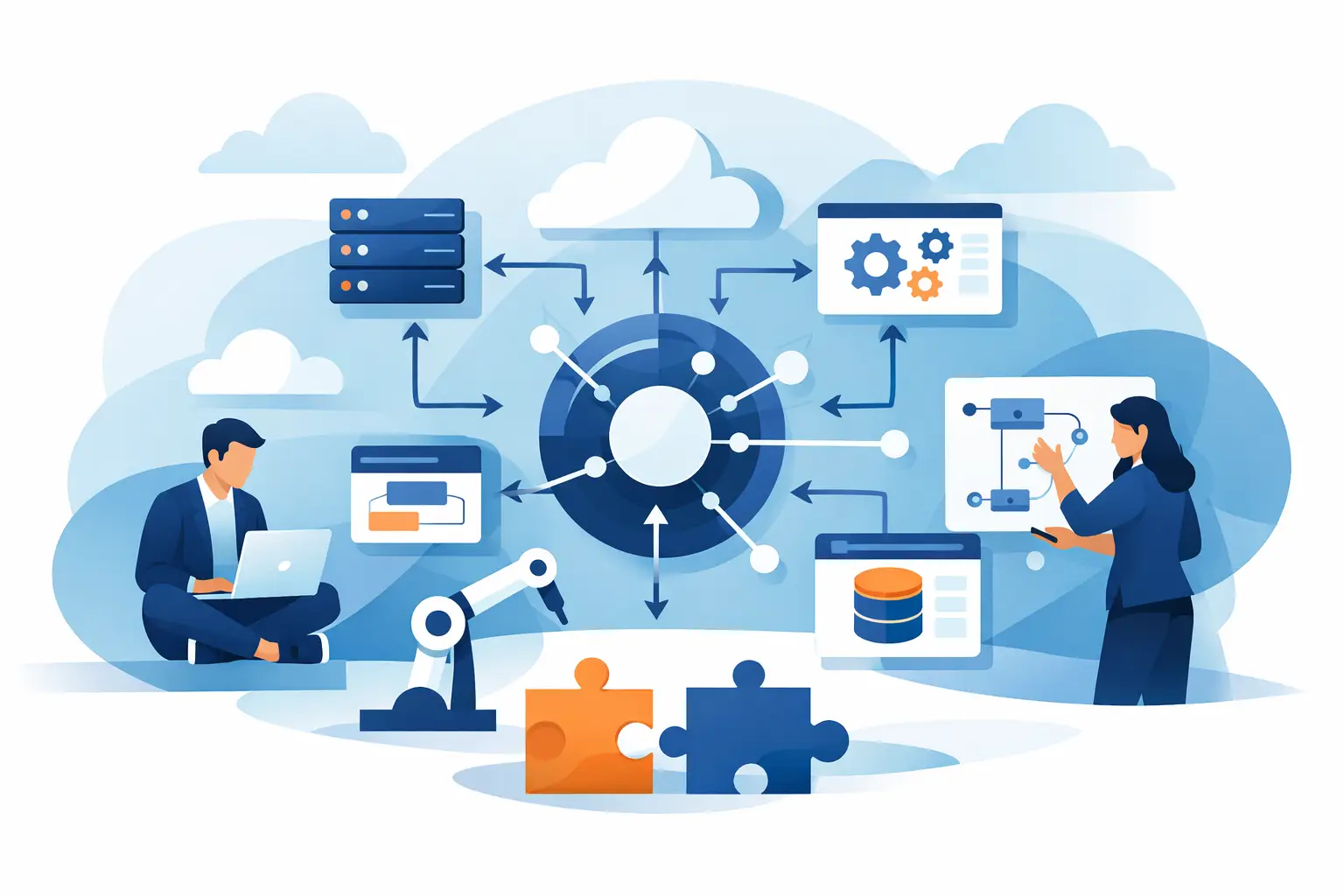
When finance works with data different from sales, the operations team relies on spreadsheets and customers receive outdated information, the problem is usually not an isolated application. It is often the absence of an integration strategy. The best approaches for system integration are not just about connecting tools for the sake of connecting: they establish how data flows, who is responsible for each piece of data, and what happens when a process fails.
For a growing company, integrating systems is a decision of architecture and operation. It can reduce manual tasks, improve visibility over orders or inventory, and eliminate reconciliation errors. But poorly designed integration can also turn a minor change into a risk for the entire platform. Therefore, the starting point should be the business process and its criticality, not the latest technology.
Start with Business Flows and Data Ownership
Before choosing APIs, middleware, or message queues, it is advisable to identify the flows that generate the most cost, delays, or risk. For example, customer onboarding may start in the CRM, trigger a credit validation in the ERP, and end in a billing platform. If each system interprets the customer's status differently, integrating the three will not solve the underlying problem.
The first task is to define the master system for each relevant entity: customer, product, order, employee, or invoice. A master system is not necessarily the oldest or the most complete; it is the one that must have the authority to create or modify a specific piece of data. This decision avoids update cycles, duplicates, and hard-to-diagnose conflicts.
Exceptions must also be documented. A canceled order, a partial return, or a customer with incomplete data may be infrequent cases, but they determine the actual quality of the integration. Organizations that only model the ideal path often discover operational costs after deployment.
Choose the Right Integration Pattern
There is no single correct architecture. The choice depends on volume, the need for real-time information, the maturity of existing systems, and the impact of a temporary inconsistency. The most common patterns respond to different needs.
API Integration for On-Demand Operations
APIs are appropriate when an application needs to query or execute a specific action in another. For example, a B2B portal may request the current availability of a product from the ERP before confirming an order. This model offers immediate responses and clear boundaries between systems.
The main risk arises when long chains of synchronous dependencies are built. If the portal depends on the CRM, which depends on a pricing service, and this on an ERP, a failure or high latency can affect the entire user experience. APIs should be designed with time limits, controlled retries, caching mechanisms when appropriate, and clear responses in case of unavailability.
Events for Decoupled and Scalable Processes
An event-driven architecture is useful when a business event must trigger actions in multiple systems. For example, creating an order can generate an event that updates inventory, notifies logistics, feeds analytics, and activates communication to the customer.
This approach reduces direct coupling between applications and facilitates the incorporation of new consumers. In return, it requires discipline: events must have versioned contracts, unique identifiers, and a precise definition of their meaning. It is not enough to emit a message called `order_updated`; it must specify what changed, when it happened, which system originated it, and how the receivers should process it.
Consistency is often eventual, not instantaneous. This is acceptable for many operations, such as analytics updates or notifications, but may not be for credit control or stock reservations. The criterion should be operational, not ideological.
Batch Processes for Non-Critical Real-Time Data
Batch integrations remain a valid option for periodic synchronizations, migrations, or loading analytical data. They are easier to monitor in environments with legacy systems and can be less costly than a permanent event platform.
The mistake is to use them for processes that require immediacy. If a sales team checks data from the previous night every morning, that may be sufficient. If a customer needs to know the real status of a shipment, a nightly update generates calls, incidents, and loss of trust. The frequency should respond to a quantifiable business need.
Avoid Uncontrolled Point-to-Point Connections
Connecting each application directly with others seems quick at first. A developer creates an integration between the CRM and the ERP; another adds a connection from the ERP to the warehouse; a third exports data from the CRM to a marketing tool. In no time, the company has a network of dependencies that no one fully understands.
Point-to-point connections may be reasonable for a simple, stable, and limited need. The problem arises when they become the dominant model. Every change in a field, credential, or business rule requires reviewing multiple integrations, and traceability becomes insufficient.
A well-thought-out integration layer - through an integration platform, an API gateway, domain services, or messaging - should not add bureaucracy. It should concentrate repeatable responsibilities: authentication, format transformation, activity logging, error management, and version control. The goal is not to centralize all code but to reduce opaque dependencies.
Design for Failure, Not Just for the Right Case
Every integration depends on networks, credentials, usage limits, and external systems. Therefore, it will fail at some point. The difference between a reliable integration and a fragile one lies in how it behaves then.
Retries should be limited and staggered to avoid overloading a service that is already in trouble. Operations must be idempotent: if a message is processed twice, it should not create two invoices or duplicate an order. Messages that cannot be processed need an error queue and a defined procedure for review.
Observability is equally relevant. Teams must be able to respond quickly to basic questions: which order did not synchronize?, at which step did it fail?, which system contains the correct data?, how long has the incident been open? Structured logs, latency metrics, error alerts, and end-to-end traceability turn an integration into an operable service, not a set of hard-to-maintain scripts.
Treat Security and Governance as Design Requirements
Integrations often move sensitive data between systems: customer information, financial data, contracts, or credentials. Including security at the end often forces a redesign of already deployed components.
Each connection must apply the principle of least privilege. An integration that only needs to query orders should not be able to modify users or download financial information. Credentials must be stored and rotated in a controlled manner, never embedded in code, spreadsheets, or unprotected configurations.
Governance also includes data contracts and change control. When a team removes a field from an API or modifies the meaning of a status, the impact must be visible before reaching production. Versioning interfaces, maintaining useful documentation, and establishing a change review reduces interruptions that are often mistakenly attributed to "integration issues."
Measure Operational Outcome, Not Just the Number of Connections
An integration does not add value because it uses advanced technology or connects more applications. It must improve a relevant metric: reduce order processing time, decrease billing errors, shorten financial reconciliation, or increase information availability for operations managers.
It is advisable to define a baseline before starting. If the goal is to reduce manual work, it is necessary to measure how many hours are currently invested, how many corrections are needed, and what the costs of delays are. This reference allows prioritizing use cases with clear returns and prevents the initiative from drifting towards underutilized automations.
At StrateCode, this approach combines process analysis, architecture, and technical execution. The goal is not to implement an additional layer by default but to build an integration that can be operated, evolved, and justified to the business.
The best decision is often to start with a critical flow, precisely define its data and possible failures, and demonstrate a measurable improvement. From there, each new integration can reinforce a coherent architecture instead of adding another difficult-to-sustain dependency.