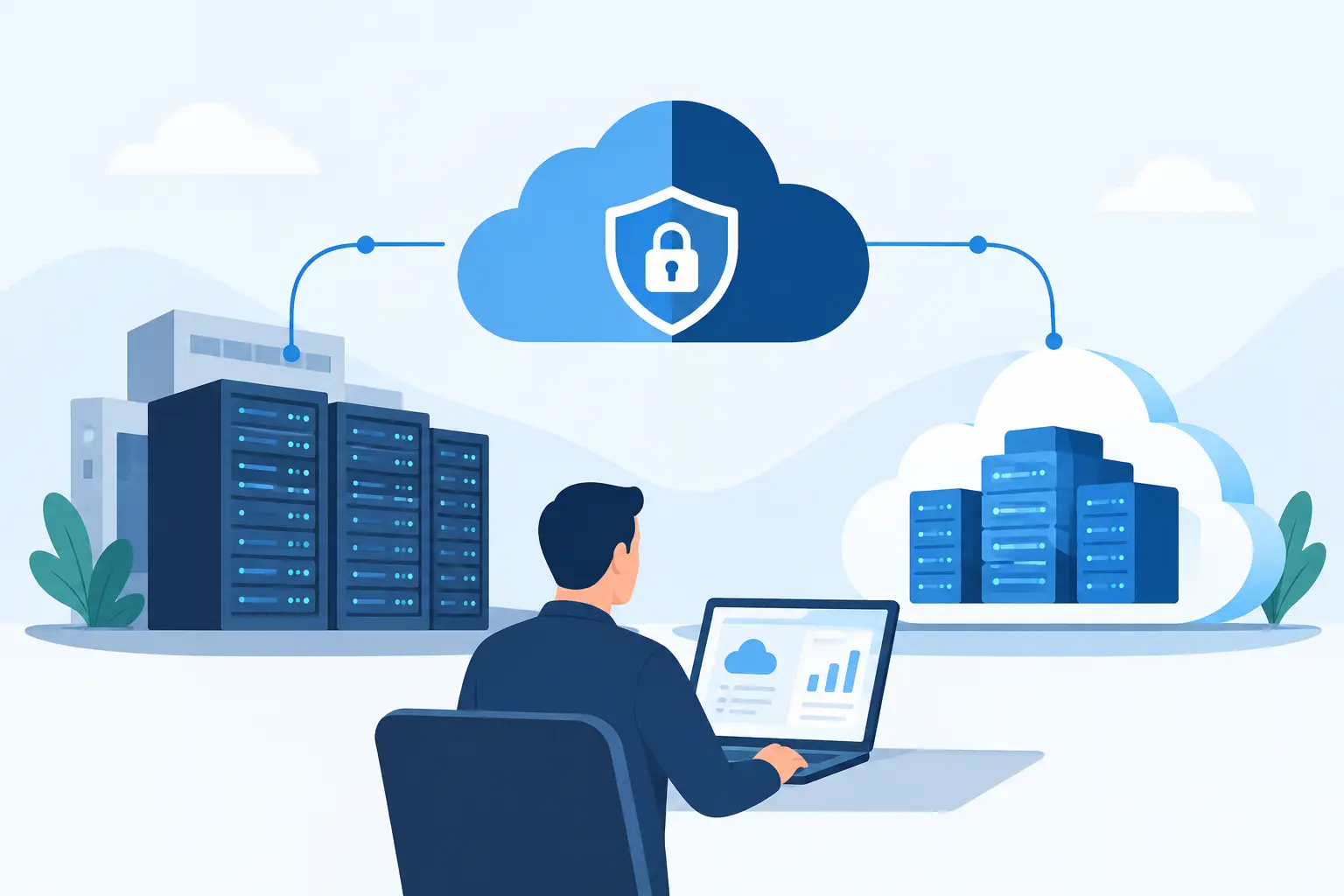
An ERP that cannot stop, a client application that demands variable capacity, and data subject to residency requirements cannot be resolved by moving everything to the same provider. In that scenario, the hybrid cloud allows for modernization in parts without abruptly relinquishing control over the systems that support the operation.
It is not an intermediate solution due to a lack of decision nor a simple coexistence between on-premises servers and cloud services. When well-designed, it is an operational architecture where each workload runs where it adds the most value: by cost, latency, compliance, technological dependency, or business criticality. Poorly conceived, it adds layers of complexity, duplicates controls, and turns the infrastructure into a source of costs that are difficult to explain.
For a CTO, CIO, or operations manager, the question is not whether the hybrid cloud is modern. The question is whether it addresses a specific limitation of the company with a level of governance that the team can maintain.
What is a hybrid cloud in operational terms
A hybrid cloud integrates private infrastructure environments—whether they are owned data centers, hosted servers, or private platforms—with public cloud services. The integration must be real: secure connectivity, consistent identity, applicable security policies, shared observability, and defined mechanisms for deploying, operating, and recovering services.
Having a database on an on-premises server and a SaaS tool on the internet does not, by itself, constitute a hybrid architecture. Nor does opening a cloud account to host a new isolated application. The model makes sense when the components exchange data or processes under clear technical and operational rules.
For example, an industrial company may keep plant control systems close to its facilities to limit latency and maintain local continuity. At the same time, it can send selected data to the public cloud for analytics, demand forecasting, or training artificial intelligence models. The value lies in the deliberate separation of responsibilities, not in the mixing of technologies.
When the hybrid cloud provides a real advantage
The main reason to adopt this model should not be to retain existing servers. Maintaining local infrastructure solely because it is already amortized often postpones a modernization problem without eliminating it. The decision makes more sense when there are constraints that justify a distribution of workloads.
A common case is the modernization of critical applications. Many organizations depend on monolithic software, point-to-point integrations, and databases that cannot be migrated without operational risk. A hybrid strategy allows encapsulating that core while building new services in the cloud: portals for customers, automations, integration layers, data analytics, or APIs for partners. This way, the company gradually reduces dependencies instead of betting the entire operation on a massive migration.
It is also useful when demand is irregular. An e-commerce platform, a monthly calculation process, or a development environment may require significantly higher resources during specific periods. The public cloud provides elasticity for those workloads, while stable and predictable systems can remain on private infrastructure if their total cost and performance requirements justify it.
Regulatory compliance is another factor. Not all data has the same sensitivity nor is subject to the same rules. Classifying information allows maintaining certain records, keys, or processes under specific controls and leveraging managed services for the rest. However, it is advisable to avoid a simplistic interpretation: hosting data in a specific location does not eliminate the obligation to control access, encryption, traceability, and retention.
The right decision is made workload by workload
The question "Do we migrate to the cloud?" is often too broad to produce a good decision. It is more effective to evaluate each application, data flow, and dependency. The analysis should consider the criticality of the service, recovery objectives, acceptable latency, integrations, consumption patterns, and operating costs over several years.
An application with constant usage, low latency requirements, and strong dependence on local equipment may not be a good candidate for immediate migration. Conversely, a reporting solution that needs to process large volumes once a day may clearly benefit from managed elastic services.
There are also workloads that should not be moved as they are. Moving a legacy application to virtual machines in the cloud may reduce pressure on the data center but retains its maintenance, security, and deployment issues. In some cases, it is a valid tactical measure; in others, it merely changes the bill and expands the operational surface. The alternative may be to refactor specific components, replace standard functions with managed services, or retire duplicate applications.
The architecture must respond to business priorities. If the goal is to accelerate product launches, it will be advisable to prioritize development platforms, deployment automation, and APIs. If the problem is operational continuity, the focus will be on redundancy, immutable backups, recovery testing, and network segmentation. The same hybrid cloud does not serve both objectives without distinct decisions.
The risks that often arise after the first deployment
The main risk is not technical but governance-related. When teams adopt cloud services without a common model for identity, networks, tagging, budgets, and permissions, the infrastructure grows faster than the capacity to manage it. Resources appear without owners, oversized accounts, data replicated without criteria, and permanent accesses that no one reviews.
Connectivity deserves special attention. Many designs depend on links between the private environment and the public cloud that become single points of failure or bottlenecks. It is not enough for the connection to work under normal conditions. Latency, bandwidth, degradation, and behavior during a partial outage must be measured. Critical processes must have a defined response when that connectivity is unavailable.
Cost is another point of friction. The public cloud reduces initial investment but does not guarantee automatic savings. Data transfer, forgotten environments, poorly configured long-term storage, and oversizing can quickly erode the business case. The FinOps discipline is not just about cutting expenses: it connects technical decisions with budgets, forecasts, and accountability for product or team.
Finally, security cannot be divided by provider. The company remains responsible for configuring identities, protecting secrets, validating access, logging activity, and responding to incidents. The shared responsibility model does not transfer those tasks; it delineates which part the provider covers and which part the organization must govern.
How to design a hybrid cloud that the team can operate
A sustainable implementation starts with a base architecture, not with the first application. This base must define how environments connect, how networks are segmented, how identities are federated, and how security policies are applied. Decisions should be documented as reusable standards, not as manual configurations tied to a person.
Infrastructure as code is key at this point. Networks, permissions, environments, and services must be deployable in a repeatable and reviewable manner. This reduces errors, accelerates recovery, and prevents production from becoming a set of difficult-to-understand exceptions. Alongside this, delivery pipelines should include security validations, testing, and approval controls appropriate to the criticality of each service.
Observability must cross boundaries. If a transaction fails, the team needs to trace it from the application to the database, the network, and external services, regardless of where each component runs. Centralizing metrics, logs, and alerts does not eliminate all incidents, but it reduces the time needed to diagnose their origin.
It is advisable to establish a taxonomy of owners, environments, products, and cost centers from the outset. Each resource should have a technical owner and a business owner. Without this traceability, cost, risk, and capacity reviews become manual exercises that arrive too late.
A gradual roadmap reduces risk
Phased migration often yields better results than a program based on arbitrary dates. First, the actual inventory of applications, data, integrations, and dependencies is identified. Then, a target architecture is defined, and initial cases with limited impact are selected, but sufficient to validate connectivity, deployment, support, and governance.
The first projects should generate reusable capabilities. A well-built integration, a common deployment platform, or a federated identity model provides more value than several isolated migrations. Success is not measured solely by the number of workloads moved but by the reduction of delivery times, incidents, unit costs, or exposure to risk.
StrateCode approaches these programs by combining architecture evaluation, engineering execution, and knowledge transfer to the internal team. This combination allows the roadmap to respond to real business constraints and not depend indefinitely on improvised solutions.
The best hybrid cloud is the one that makes difficult decisions explicit: what should remain close to the operation, what is advisable to modernize, what data can circulate, and who assumes each responsibility. When those answers are clear, technology stops being an accumulation of platforms and becomes an operational capability that can evolve with the business.