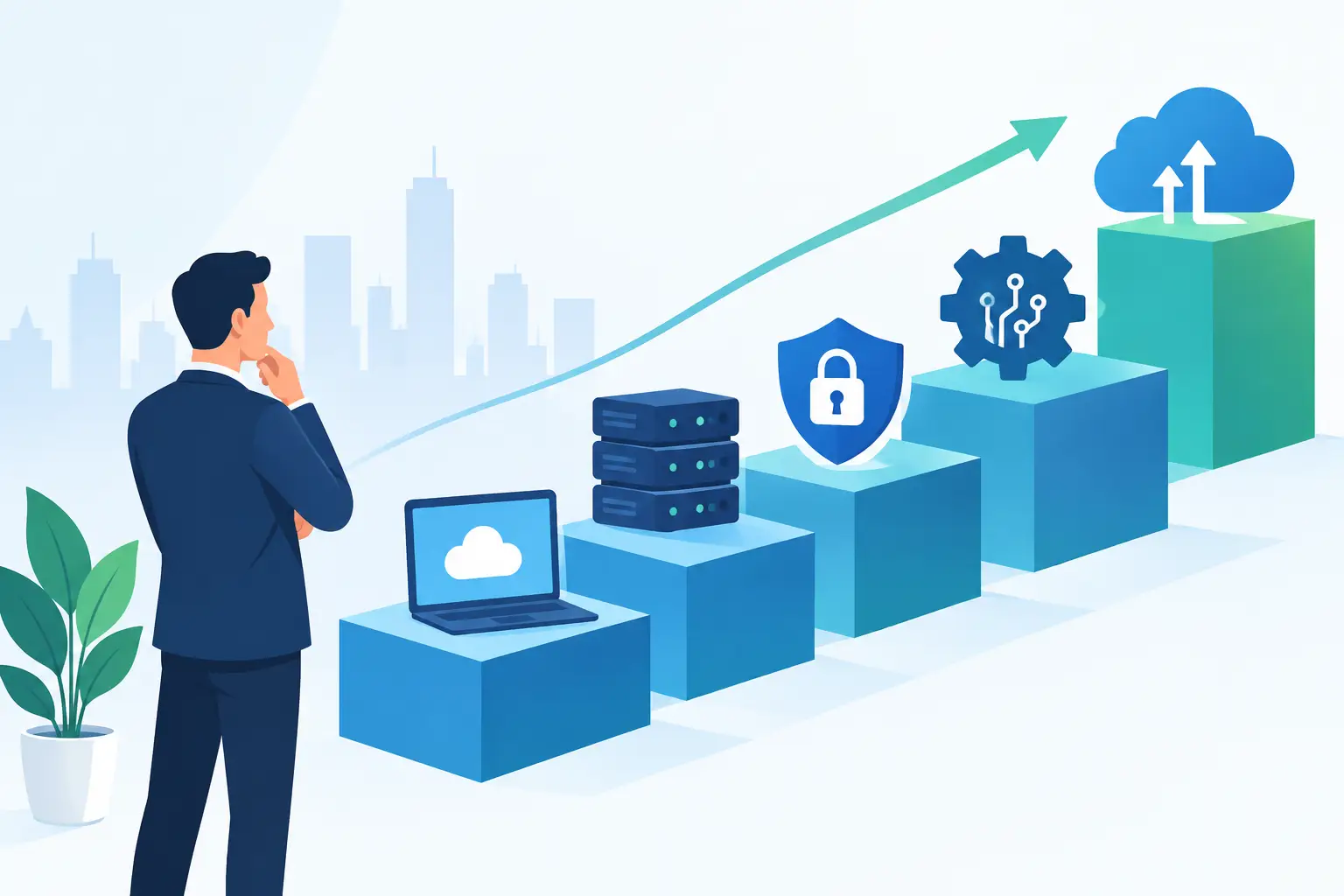
A legacy system does not become a problem because of its age, but when it hinders a business decision, forces manual processes, or increases operational risk every time the business changes. Therefore, technology modernization priorities should not be defined based on a list of trendy technologies, but rather on the constraints that are already affecting revenue, costs, reliability, and execution capacity.
For a COO, the signal may be a team reconciling data in spreadsheets every week. For a CTO, it may be a monolithic application where a seemingly minor modification requires weeks of testing. For a CIO, it may involve infrastructure that is difficult to audit and protect. The technical origin varies, but the investment criterion is the same: intervene where the architecture demonstrably limits business performance.
Technology Modernization Priorities: Start with Impact
Modernization does not mean rewriting everything. In many organizations, a total replacement multiplies risk, disrupts operations, and consumes budget before generating value. The right approach is to identify which components need to evolve first, which can be stabilized, and which should be retired.
The highest priority is often found in systems that combine operational criticality and technical fragility. These are platforms that process orders, billing, inventory, customer service, or financial data, but rely on undocumented knowledge, point-to-point integrations, or infrastructures without proven recovery capability. Any failure in these areas has a direct translation into service loss, manual work, or regulatory exposure.
The second priority is to eliminate friction in repetitive processes. When a workflow depends on copying data between applications, validating information via email, or generating reports manually, the company pays for it every day. Automation and integration not only reduce administrative time: they improve data quality and allow teams to work with more up-to-date information.
It is also advisable to prioritize bottlenecks that condition growth. A system may work for one hundred users and fail for a thousand. It may support one line of business and complicate every new acquisition, channel, or country. Modernization must prepare the necessary capacity for the company's actual plan, not for a hypothesis of indefinite growth that oversizes the investment.
The Diagnosis Must Precede the Roadmap
A reliable roadmap does not start with the decision to migrate to the cloud, implement artificial intelligence, or adopt microservices. It starts with a technical and operational diagnosis that connects each limitation with a business consequence. Without that work, it is easy to allocate resources to visible but secondary problems while the causes of delays, instability, or excessive costs persist.
The diagnosis must examine the complete cycle: application architecture, data model, system dependencies, infrastructure, deployment practices, observability, security, and internal skills. It should also incorporate the experience of operations, finance, and customer service teams. They are the ones who usually know the manual exceptions and limitations that do not appear in a technical diagram.
There are four questions that help organize the discussion:
- What processes generate the most cost, errors, or delays due to reliance on manual intervention?
- Which systems present the highest risk of unavailability, data loss, or non-compliance?
- What limitations prevent launching products, serving customers, or integrating new capabilities?
- What technical debt is raising the cost and time of each change?
The answers must be supported by evidence. Hours spent on manual tasks, frequency of incidents, mean recovery time, infrastructure costs, production defects, and duration of delivery cycles allow for comparing initiatives that would otherwise compete only for internal perception.
Security, Data, and Reliability Are Not Afterthoughts
A common mistake is treating security as a final check. In legacy environments, risks are rarely limited to a specific vulnerability. They can be found in overly broad permissions, exposed secrets, unmaintained dependencies, lack of traceability, or backups that have never been restored in a real test.
Modernization is an opportunity to introduce controls from the design phase: identity management, environment segregation, centralized logging, proper encryption, and clear access policies. Not all companies need the same level of complexity, but all need to know what data they possess, who accesses it, and how to recover operations after an incident.
Data quality deserves the same treatment. An analytical platform will not resolve source inconsistencies or contradictory definitions of key indicators. Before automating reports or incorporating AI models, it is advisable to establish data owners, validation rules, and a single source of truth for the indicators that drive business and operational decisions.
Reliability, for its part, must be measured from the service perspective. It is not enough for a server to be active. The relevant question is whether a customer can complete a transaction and whether the team can detect and correct a problem before it becomes a significant incident. Instrumentation, useful alerts, and recovery procedures turn availability into a manageable capability, not just an aspiration.
Choosing the Right Modernization Pattern
There is no one-size-fits-all strategy. Gradual replacement works well when the core system continues to provide value, but certain modules are slow to modify or difficult to scale. In this case, specific capabilities can be extracted, stable interfaces built, and dependencies gradually reduced.
A selective reengineering may be necessary when the data model or business rules have become impossible to maintain. It is more demanding, but it can be justified if the costs of patching the system exceed the cost of redesigning it. The key is to define the scope and protect operational continuity during the transition.
Replacing with a standard product makes sense when the process does not differentiate the company and the market offers a mature solution. However, it should not be used to avoid complex decisions about deficient processes. Configuring a new tool over a poorly designed workflow only shifts the problem to another platform.
The cloud is not an automatic destination either. It can provide elasticity, disaster recovery, and better operational practices, but a migration without redesign can replicate inefficiencies and increase costs. Before moving workloads, it is advisable to define which components will be retired, which will be adapted, and what operating model will allow for controlling costs and performance.
Turning Investment into Verifiable Results
A modernization initiative loses credibility when communicated only in terms of activity: servers migrated, applications rewritten, or tools implemented. Management needs verifiable results. For example, reducing order processing time, shortening time to production, decreasing critical incidents, or eliminating hours of manual reconciliation.
Each phase should have a business objective, a specific technical scope, and clear acceptance criteria. This does not imply a rigid multi-year plan. It involves working with milestones that allow for validating decisions before committing to the next investment. Early learning reduces the risk of extensive programs that discover too late that they have solved the wrong problem.
It is also essential to assign internal responsibilities. A vendor can provide diagnosis, architecture, and execution, but sustainable modernization requires that company teams understand the decisions made and can operate the new systems. Knowledge transfer, useful documentation, and applied training are not ancillary deliverables: they protect the investment once the project is completed.
At StrateCode, the right approach combines that architectural discipline with real delivery capability. The strategy only creates value when it translates into changes that work in production, can be maintained, and improve a relevant business metric.
The Decision to Make Now
The best first decision is not to approve a massive program, but to agree on which operational or technical problem has the highest cost of remaining unresolved over the next twelve months. From there, a serious diagnosis allows for turning a vague concern into a defensible sequence of investments. Well-directed modernization does not pursue newer systems for their own sake: it builds a technological foundation that allows for operating with less risk and responding more accurately when the business demands change.