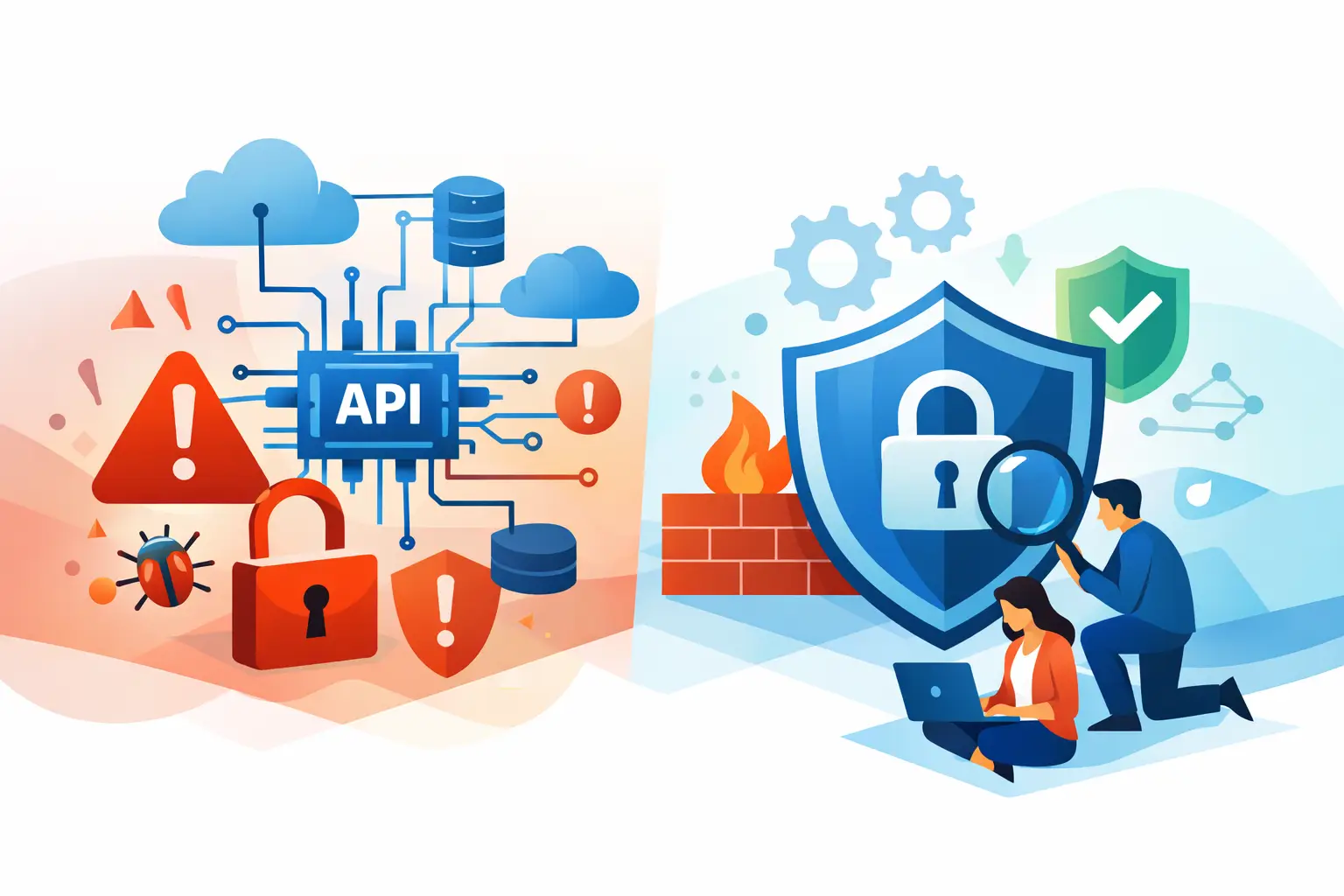
An endpoint accessible from the internet may seem like an infrastructure detail until it returns customer data, allows order modifications, or consumes resources without limits. When an address, a mobile application, or a partner can invoke a service, the question is not just what risks does an exposed API have, but what controls separate a legitimate business channel from a gateway to the system.
An exposed API is not necessarily an insecure API. Many organizations need to publish interfaces for customers, mobile applications, B2B integrations, or suppliers. The problem arises when exposure is decided for convenience, without defining the perimeter, authorized identities, allowed data, and the ability to detect abuses. The real risk depends on the criticality of the service, but also on the operational maturity that supports it.
What Risks Does an Exposed API Have in Practice
The most visible risk is unauthorized access to information or business functions. However, poor exposure rarely causes a single isolated problem. It can become a chain: an attacker identifies an endpoint, finds incomplete authorization, extracts data, and uses that information to attack other systems or impersonate users.
Unauthorized Access to Data and Operations
The most frequent failure is not always in the login. An API can correctly validate a token and still allow a user to query or modify resources that do not belong to them. This is the classic case of changing an identifier in a request to access another customer's invoice, profile, or order.
This type of vulnerability, often referred to as broken object-level authorization, is especially serious in multi-tenant platforms, customer portals, and systems with numerous roles. Authorization must be checked on every operation and for each resource, not just when issuing the token. Trusting that the user interface hides an option does not protect the API: a request can be constructed outside of that interface in seconds.
There are also operations that seem secondary, such as exporting records, regenerating credentials, modifying preferences, or querying histories. If they are not reviewed with the same rigor as a main transaction, they can expose sensitive information or allow changes with commercial and operational impact.
Exposure of Credentials and Secrets
APIs often rely on keys, tokens, certificates, connection strings, and third-party secrets. When these values appear in repositories, configuration files, logs, or error responses, an attacker can gain persistent access without exploiting a complex vulnerability.
The damage is not limited to the affected service. A reused key between environments or with excessive permissions can open access to cloud storage, messaging queues, analytics tools, or payment APIs. Therefore, secret management must be part of the platform design: centralized storage, rotation, minimum permissions, and prohibition of including credentials in code or mobile clients.
Automated Abuse and Service Degradation
A public API can be the target of mass enumeration, scraping, fraud, brute force attacks, and deliberate capacity consumption. Even a correctly authenticated endpoint can suffer abuse if it does not limit the frequency, data volume, or computational cost of each request.
The business impact can take various forms: unexpected cloud bills, service outages for legitimate users, blocking internal processes, or degrading critical integrations. In operations involving inventory, reservations, payments, or quotes, a few minutes of unavailability can translate into direct losses and a deteriorated customer experience.
Rate limits are necessary, but they are not sufficient on their own. They must be combined with quotas per client, mandatory pagination, size limits, reasonable timeouts, and mechanisms to prioritize legitimate traffic. The appropriate policy depends on the usage pattern: a partner API with predictable traffic requires different controls than an API open to millions of users of a mobile application.
Insufficient Validation and Attacks on Internal Systems
Every field received by an API is an untrusted input. If it is not validated according to a strict contract, it can lead to injections, query manipulation, processing of malicious files, or excessive memory and CPU consumption. The risk increases when the API transmits data to databases, search engines, legacy systems, or third-party services.
Error responses also deserve attention. Messages with internal paths, component versions, table structures, or complete traces facilitate technical reconnaissance. For the user, there should be a clear and controlled error; for the engineering team, the details should remain in protected and correlated logs.
Loss of Control Over Dependencies and Third Parties
An API does not operate in isolation. It may rely on libraries, gateways, SaaS services, identity providers, and internal systems that evolve at different rates. An incompatible change, a vulnerable dependency, or a third-party integration with excessive permissions can affect the entire flow.
Exposure grows when there is no inventory of endpoints, versions, and consumers. An old version may remain active because an external client depends on it, even though it no longer receives fixes. The result is an attack surface that no one explicitly assumes, but that remains available.
The Cost of an Exposed API Goes Beyond a Breach
Data leakage is the most obvious consequence, but it is not always the most costly. A compromised API can alter business data, generate false orders, divert approval processes, or contaminate analytical systems. Restoring the integrity of information requires reviewing logs, reconstructing states, and verifying transactions, tasks that can take longer than the technical containment itself.
There is also a governance cost. If the organization cannot determine which endpoint was used, with what identity, from where, and on what resources, the incident response becomes slow and uncertain. At the executive level, this complicates informing customers, fulfilling contractual commitments, and making proportionate decisions.
Finally, makeshift solutions often create debt. Completely shutting down an API necessary for the business can disrupt digital channels; keeping it open without controls maintains the risk. The response must preserve the business function while verifiably reducing exposure.
How to Reduce the Risks of an Exposed API
The first step is to classify each API according to its audience and sensitivity. A public catalog query endpoint is not the same as an administrative interface, a partner integration, or an internal service. This classification determines whether it should be accessible from the internet, require strong authentication, be limited by network, or operate behind a specific gateway.
Design Authentication and Authorization Separately
Authentication answers who is making the request. Authorization answers what they can do on a specific resource. Both decisions must be explicit and verifiable in the backend. Tokens with excessive duration, overly broad roles, and centralized but incomplete checks are common sources of exposure.
It is advisable to apply the principle of least privilege, separate read and write permissions, and define access scopes for each integration. For highly sensitive internal communications, mechanisms such as client certificates or workload identities can provide more control than a shared static key.
Protect the Perimeter Without Relying Solely on It
An API gateway allows centralizing authentication, traffic limits, versioning, and observability. An application firewall can filter known patterns. Both are useful controls, but they do not replace validations and authorizations in the service.
The architecture must assume that an attacker can reach the endpoint. Therefore, each service needs to validate schemas, normalize inputs, restrict methods, and return only the necessary fields. Reducing the information in responses decreases the impact of an authorization failure and limits reconnaissance capabilities.
Turn Observability into a Security Control
Logging requests does not equate to having useful traceability. Events must allow relating a call to an identity, a client, a resource, an action, and a result, without storing secrets or unnecessary personal data. Alerts should focus on behaviors: error spikes, enumerations, off-hours access, privilege changes, or unusual downloads.
This visibility allows detecting incidents before they become a significant disruption. It also facilitates reviewing the actual use of the API and removing endpoints or permissions that no longer add value.
Test as an Attacker Would
Functional tests verify that the API does what is expected. Security tests must demonstrate that it rejects what it should not allow. This includes attempting to access other users' resources, reusing tokens, sending malformed payloads, exceeding traffic limits, and forcing error routes.
The review should be integrated into the delivery cycle, with dependency analysis, automated authorization tests, and contract change reviews. Periodic audits remain necessary, especially before opening a new integration, exposing sensitive data, or migrating a legacy platform.
A well-exposed API is not one that is available to anyone, but one that offers controlled, measurable access aligned with a specific business need. Treating each endpoint as an operational asset, rather than just a simple URL, allows growth without turning connectivity into a permanent source of risk.