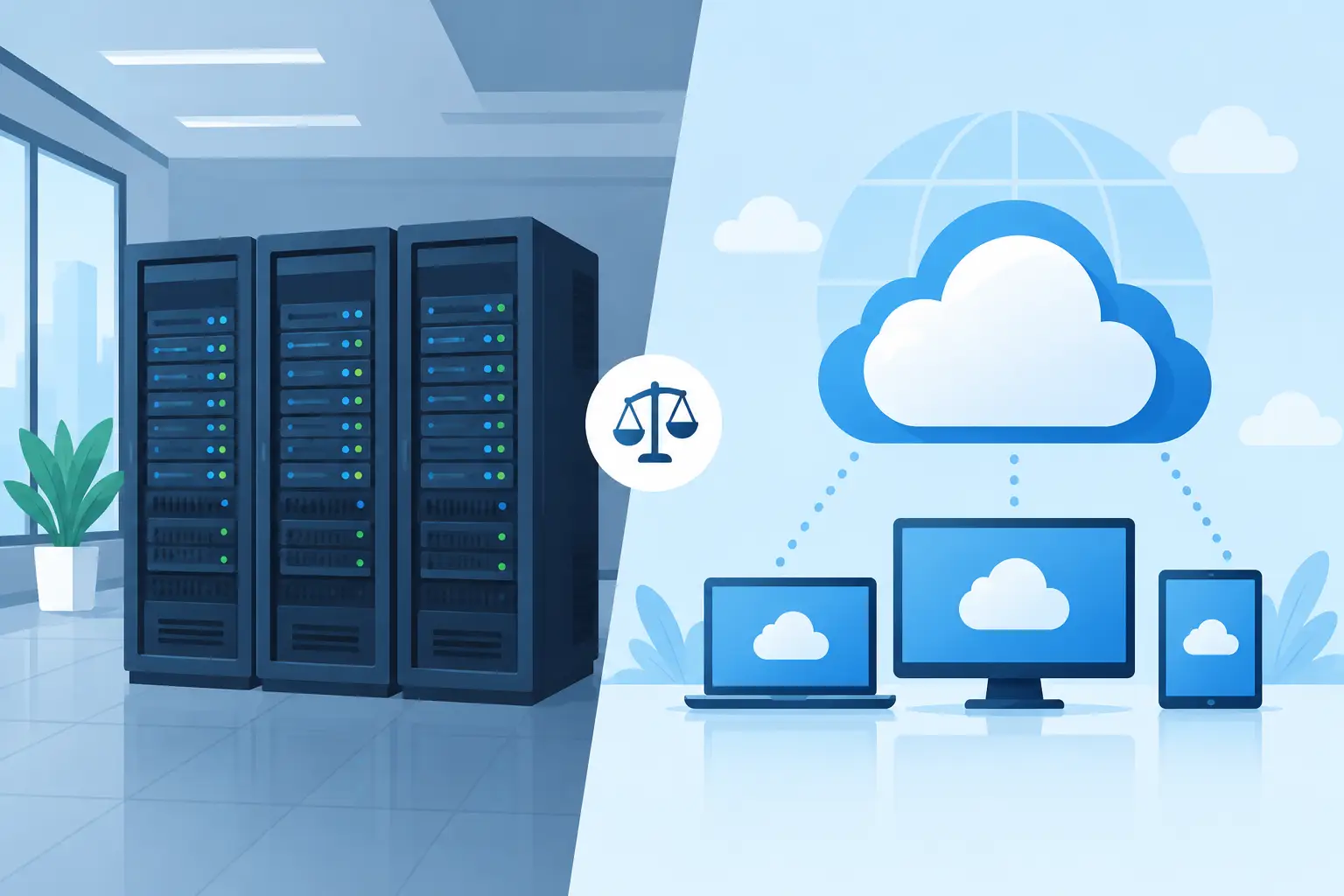
A critical application that responds in seconds, a plant that cannot stop, or a team working with sensitive data raises a more complex question than simply choosing a trendy technology. In the debate over on-premises servers vs cloud, the right decision depends on workload, regulatory obligations, internal operational capacity, and growth objectives. Adopting the cloud without an appropriate architecture can increase costs and create dependencies. Maintaining all infrastructure on-premises can limit adaptability and prolong inherited risks.
On-Premises Servers vs Cloud: The Decision is Not Binary
On-premises servers are physical equipment located at the company's facilities or in a contracted and managed data center. The organization controls the hardware, network, storage, renewal cycles, and access policies. This model offers predictability over certain resources but also concentrates operational responsibility on the internal team or a specialized provider.
The cloud provides computing resources, storage, and managed services on demand. Instead of acquiring capacity for the anticipated peak over the coming years, the company can provision resources and adjust them as needed. This accelerates certain projects but does not eliminate engineering work: it changes the type of decisions that need to be made, from network design and permissions to observability, resilience, and financial control.
The comparison should not be reduced to ownership versus rental. An on-premises environment can be virtualized, automated, and well-secured. A cloud platform can be rigid, expensive, and difficult to operate if a legacy application is moved without redesigning it. The question is which model reduces operational risk and better supports the value generated by each system.
The Real Cost Includes Much More Than the Monthly Bill
The economic argument often starts with acquisition cost. On-premises infrastructure requires an initial investment in servers, racks, networking equipment, licenses, energy, physical space, and support contracts. It also requires planning for renewals, typically every three to five years, and sizing capacity before accurately knowing future demand.
In the cloud, entry is more flexible because spending is tied to consumption. However, pay-as-you-go does not guarantee efficiency. Oversized machines, active development environments outside of hours, backups without retention policies, and data transfers between services can turn an initially attractive bill into a recurring cost that is hard to justify.
The financial assessment should consider the total cost of ownership over a three to five-year horizon. This includes operations personnel, maintenance, licenses, connectivity, backup, disaster recovery, data exit costs, and downtime. It should also include opportunity cost: if a new capability takes six months to be available on-premises and can be deployed in days in the cloud, that delay has commercial and operational impact.
For stable, intensive, and predictable workloads, a well-utilized on-premises infrastructure can be competitive. For variable demands, new projects, or products with uncertain growth, the cloud often offers a better balance between speed and capital commitment. The answer changes when analyzing each workload, not when comparing one bill to another.
Security, Compliance, and Operational Control
Keeping servers on-premises does not automatically mean having greater security. Protection depends on identity management, patching, network segmentation, encryption, immutable backups, monitoring, and incident response capabilities. An unmaintained on-premises server can expose more risk than a properly configured cloud platform.
The cloud operates under a shared responsibility model. The provider protects the physical infrastructure and base services, while the company remains responsible for identities, permissions, configuration, data classification, applications, and many network controls. Configuration errors, such as exposed storage or excessive permissions, remain a common cause of incidents.
Compliance obligations can sway the decision but rarely force a single option. Regulated sectors may require specific data residency, traceability, environment segregation, or well-defined access controls. Major cloud providers offer capabilities to address these requirements, although they must be validated against applicable regulations, customer contracts, and internal policies.
Control is another relevant nuance. In an on-premises environment, the organization physically controls the hardware and can adapt low-level components. In the cloud, it controls configuration and logical design but accepts the limits of the contracted service. For many companies, that standardization reduces operational burden. For others, especially with industrial systems, latency requirements, or specialized dependencies, it may prove insufficient.
Performance, Availability, and Business Continuity
Physical proximity still matters. Applications that process machinery data, real-time video, warehouse operations, or transactions with strict latency requirements can benefit from servers close to the point of use. In these cases, sending all information to a cloud region before acting introduces delays and connectivity dependencies that are not always acceptable.
The cloud offers clear advantages in geographic availability, scaling, and recovery. It is possible to distribute services across zones, automate backups, and spin up alternative environments more quickly than in traditional infrastructure. But these capabilities do not appear by default. An application deployed on a single cloud instance still has a single point of failure.
Continuity must be defined with two business metrics: the recovery time objective and the recovery point objective. The first establishes how long a system can remain out of service; the second determines how much information can be lost at most. Without these objectives, it is impossible to design a proportionate architecture. There is a risk of paying for high availability where it does not add value or, worse, discovering that a critical process cannot be recovered within the necessary timeframe.
When Each Model is Appropriate
On-Premises Infrastructure
On-premises servers often make sense when demand is stable, specialized hardware is essential, or low latency is an operational condition. They may also be suitable if there is already a recent investment, a capable team to manage it, and a proven continuity strategy. The mistake would be to keep them solely out of inertia, without measuring their utilization, exposure to failures, and the cost of maintaining obsolete platforms.
Public or Managed Private Cloud
The cloud is especially useful for accelerating launches, enabling development and testing environments, absorbing seasonal peaks, integrating data or artificial intelligence services, and expanding geographic presence. It is also valuable when the company needs to replace aging infrastructure without facing an immediate capital renewal.
However, migrating a legacy application as it is rarely leverages its full potential. Before moving it, it is advisable to review dependencies, databases, access patterns, storage consumption, and availability requirements. Some applications need gradual modernization; others must temporarily remain where they are while their most critical components are decoupled.
Hybrid Architecture
For many organizations, the most rational option is hybrid. Latency-sensitive systems or those tied to local equipment can remain close to operations, while analytics, backups, customer portals, automation, and variable workloads run in the cloud. This combination allows for a gradual transition and prevents a strategic decision from becoming a disruptive migration.
The hybrid model requires discipline. It is necessary to define which data are synchronized, where the source of truth resides, how common identities are managed, and what happens if connectivity fails. Without these rules, flexibility becomes distributed complexity.
A Decision-Making Process Based on Workloads
The decision should begin with a real inventory of applications, servers, databases, integrations, and information flows. It is not enough to know how many machines exist. It is necessary to identify which systems generate revenue, which support internal operations, what undocumented dependencies exist, and which services have a technical debt that increases the risk of change.
Next, each workload must be evaluated based on criticality, consumption pattern, data sensitivity, latency requirements, integration needs, current cost, and recovery capability. This assessment allows for prioritization. A reporting platform with monthly peaks is not treated the same as a production control system available twenty-four hours a day.
The next phase involves designing a business case and a target architecture. They should include security controls, governance model, cost forecasting, deployment automation, monitoring, and a rollback plan. Migration should not be the goal in itself. The objective is to improve reliability, delivery speed, visibility, and efficiency without compromising critical processes.
A partner with consulting and execution capabilities can help turn this analysis into a viable plan, from technical assessment to implementation and knowledge transfer to the internal team. At StrateCode, this approach starts from architecture and operational outcomes, not from a prior preference for a platform.
The best infrastructure is not the one that accumulates the most services or maintains the most in-house equipment. It is the one that allows the company to operate with control, recover from failures, and change at a pace consistent with its objectives. Before deciding, it is advisable to put each workload against that test.