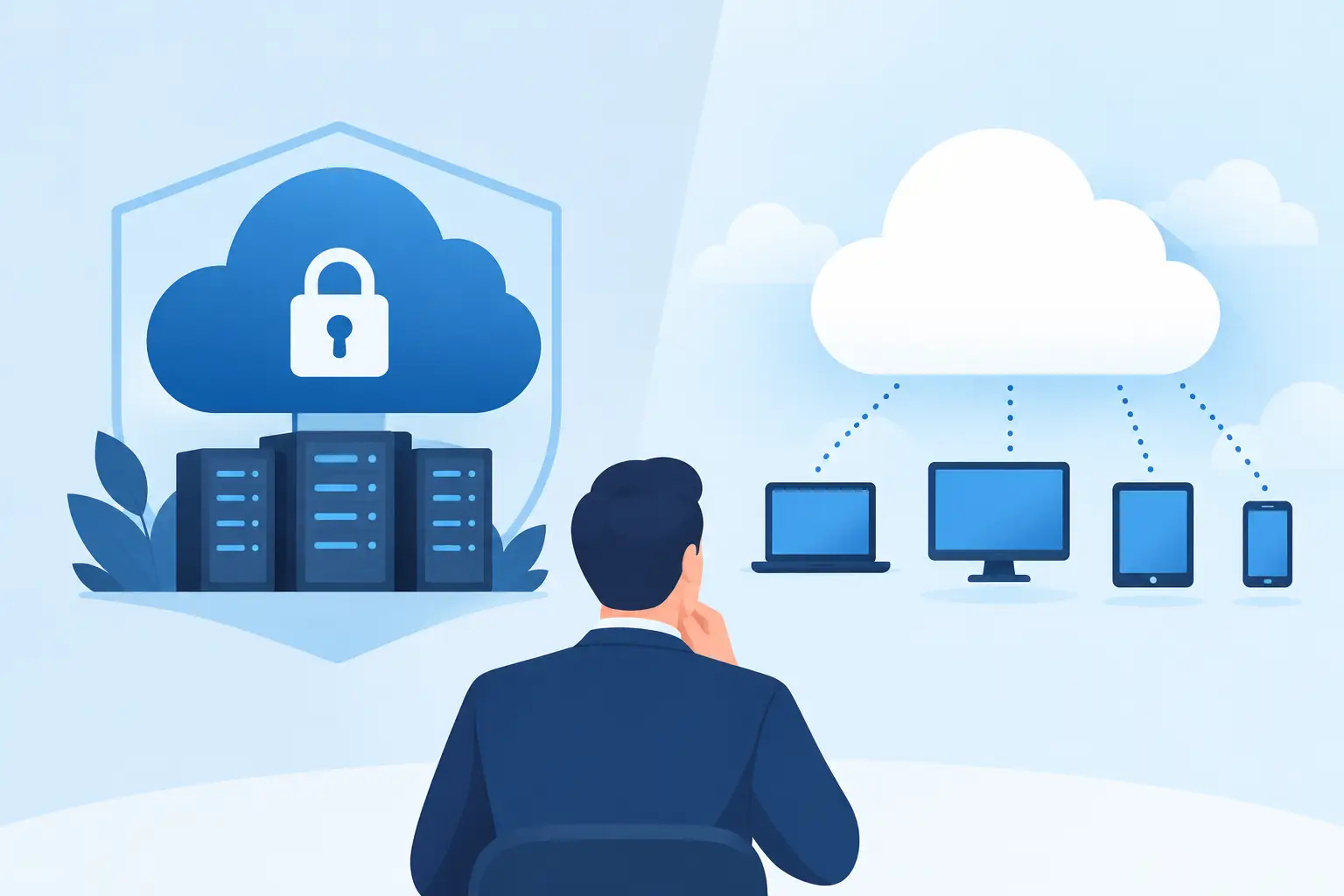
An e-commerce platform that processes occasional demand spikes does not have the same needs as a manufacturer with plant systems connected to legacy applications. However, both organizations often frame the decision as a simple private cloud vs public cloud. The correct approach is not to choose the most popular infrastructure but to determine which model reduces operational risk and supports expected growth.
The public cloud has lowered the barriers to entry for enterprise infrastructure. The private cloud retains relevant advantages when control, predictability, or regulatory compliance are determining factors. Neither is a universal answer. The right architecture depends on workloads, team maturity, consumption patterns, and business obligations.
Private Cloud vs Public Cloud: The Decision is Not Binary
In a public cloud, computing, storage, and network resources are consumed from a shared platform operated by a provider. The company contracts capacity on demand and accesses a wide catalog of managed services. It is a model designed for speed, elasticity, and rapid provisioning.
A private cloud reserves the infrastructure for a single organization. It can be hosted in a company-owned data center, at a provider's facilities, or built on dedicated hardware. The decisive element is not where the equipment is physically located, but the level of isolation, configuration control, and governance maintained by the company.
The comparison loses value when limited to security versus agility. A well-designed public cloud can surpass the security of a poorly managed private environment. Similarly, a private cloud does not automatically equate to high costs if it supports stable, intensive, and properly sized workloads. The question is what responsibilities your organization can and should assume.
Differences Affecting Operations
Scalability and Speed of Delivery
The public cloud allows environments to be deployed in minutes, automates capacity, and absorbs traffic variations without purchasing hardware in advance. This is especially useful for digital products with variable demand, data initiatives, development environments, and expansion into new regions.
This benefit requires discipline. If each team creates resources without labeling standards, budget limits, or lifecycle policies, initial speed turns into complexity and difficult-to-attribute spending. Elasticity does not replace capacity planning; it changes how it is done.
The private cloud requires more preparation to scale resources. In return, it can offer very predictable performance for applications with continuous use and specific latency requirements. In industrial production systems, intensive transactional processing, or platforms with very sensitive dependencies, that predictability can have direct value for operations.
Technical Control and Customization
The private model offers greater control over the network, hardware, platform versions, and access policies. It may be appropriate when a legacy application depends on configurations that do not fit standard services or when there is a justified need for physical isolation.
The downside is clear: the internal team, or a technical partner, must take on tasks that in the public cloud fall to the provider. Patching, equipment renewal, capacity monitoring, backups, and disaster recovery require ongoing processes, budget, and skills. Having more control only generates value if the organization can exercise it consistently.
Cost and Financial Predictability
The public cloud turns a significant part of the initial investment into operational expenditure. This model reduces the cost of experimentation and avoids purchasing infrastructure for scenarios that may never materialize. It also allows access to advanced capabilities in analytics, automation, or artificial intelligence without setting up and operating the entire underlying platform.
However, paying for usage does not mean paying less. Data transfers, storage without retention policies, oversized resources, and environments that never shut down can quickly raise the bill. For stable workloads over several years, a private or dedicated environment can offer a more predictable total cost of ownership.
The comparison should include more than just the price of the virtual machine or server. It is advisable to calculate licenses, connectivity, support, energy, specialized personnel, potential downtime, technology renewal, and exit costs. The economic impact of delaying an initiative due to lack of available capacity should also be assessed.
Which Workloads Fit Best in Each Model
The public cloud is often a good option for customer-facing web applications, development and testing environments, variable analytical processing, backups, disaster recovery, and services with uncertain growth. Its main advantage appears when demand changes or when time to market affects business opportunity.
The private cloud often fits better with very constant workloads, systems with strict local latency requirements, legacy applications that are difficult to refactor, and environments subject to data residency requirements or specific controls. It may also make sense when a company already has a depreciated platform and a team capable of operating it rigorously.
There are less obvious cases. A critical database does not need to go to a private cloud just because it is critical. It can operate in a public cloud if designed with high availability, encryption, network segmentation, immutable backups, and real recovery testing. Conversely, a little-used internal application does not necessarily justify dedicated private capacity just because it stores sensitive information.
The classification should be based on facts: data sensitivity, usage pattern, dependence on local systems, recovery objectives, acceptable latency, and cost of disruption. Labeling an application as critical without specifying those criteria does not help design a defensible architecture.
Security, Compliance, and Shared Responsibility
Security is a shared responsibility in the public cloud. The provider protects the physical infrastructure and base services, while the company must configure identities, permissions, networks, encryption, logs, backups, and data policies. Many incidents do not stem from a provider vulnerability but from excessive permissions, exposed credentials, or poorly configured resources.
In a private cloud, the organization controls more layers but is also responsible for more layers. This can facilitate the application of very specific controls, although it does not eliminate the risks of configuration, human error, or lack of visibility. Dedicated isolation does not replace identity management or continuous monitoring.
For regulated sectors, the conversation must go beyond asking if a provider meets a certification. It is necessary to check where the data resides, how access is audited, what evidence can be provided, what happens in the event of a deletion request, and how recovery is tested. Compliance must translate into verifiable technical and operational controls.
The Hybrid Model May Be the Most Rational Answer
Many companies do not have to choose a single destination. A hybrid architecture can maintain low-latency systems or legacy applications on private infrastructure while using the public cloud for analytics, integration, development, recovery, or customer-facing digital channels.
This approach avoids forced migrations and allows for phased modernization. But it should not become an accumulation of exceptions. Operating two environments increases the complexity of identity, observability, networks, security, and cost governance. It only works well when there is a clear integration architecture and defined operational responsibilities.
Before adopting a hybrid model, it is advisable to identify what data will cross environments, how often, and under what controls. The cost and latency of moving information can completely alter the viability of the initial design. Improvised integration often generates dependencies that are difficult to maintain.
How to Make a Decision with Business Criteria
The first step is to build a real inventory of applications and dependencies. It is not enough to count servers. It is necessary to understand what processes each system supports, who uses it, what data it handles, what its maintenance window is, and how much an hour of downtime costs.
Next, classify workloads according to variability, criticality, recovery requirements, and compliance constraints. This analysis allows separating applications that need elasticity from those that require constant performance or physical proximity. It also identifies systems that should be retired before investing in migrating them.
The next step is to design a three- to five-year economic case. Include growth and demand reduction scenarios, not just a single linear estimate. In the public cloud, apply FinOps practices from the start: mandatory labeling, budgets, alerts, review of idle resources, and accountability by team or product.
Finally, define the operating model before deployment. Who approves access, who is responsible for incidents, how restorations are tested, and what metrics determine that the service meets its objectives are questions of architecture but also of governance. StrateCode addresses these decisions by connecting technical diagnosis with an execution plan that has accountable parties, priorities, and measurable outcomes.
The best choice will not be the one that seems most advanced in a presentation, but the one that allows your company to deliver reliable services without introducing costs, dependencies, or risks that it cannot manage. A well-decided architecture leaves room to change course when the business needs it and establishes the necessary discipline to do so without jeopardizing operations.