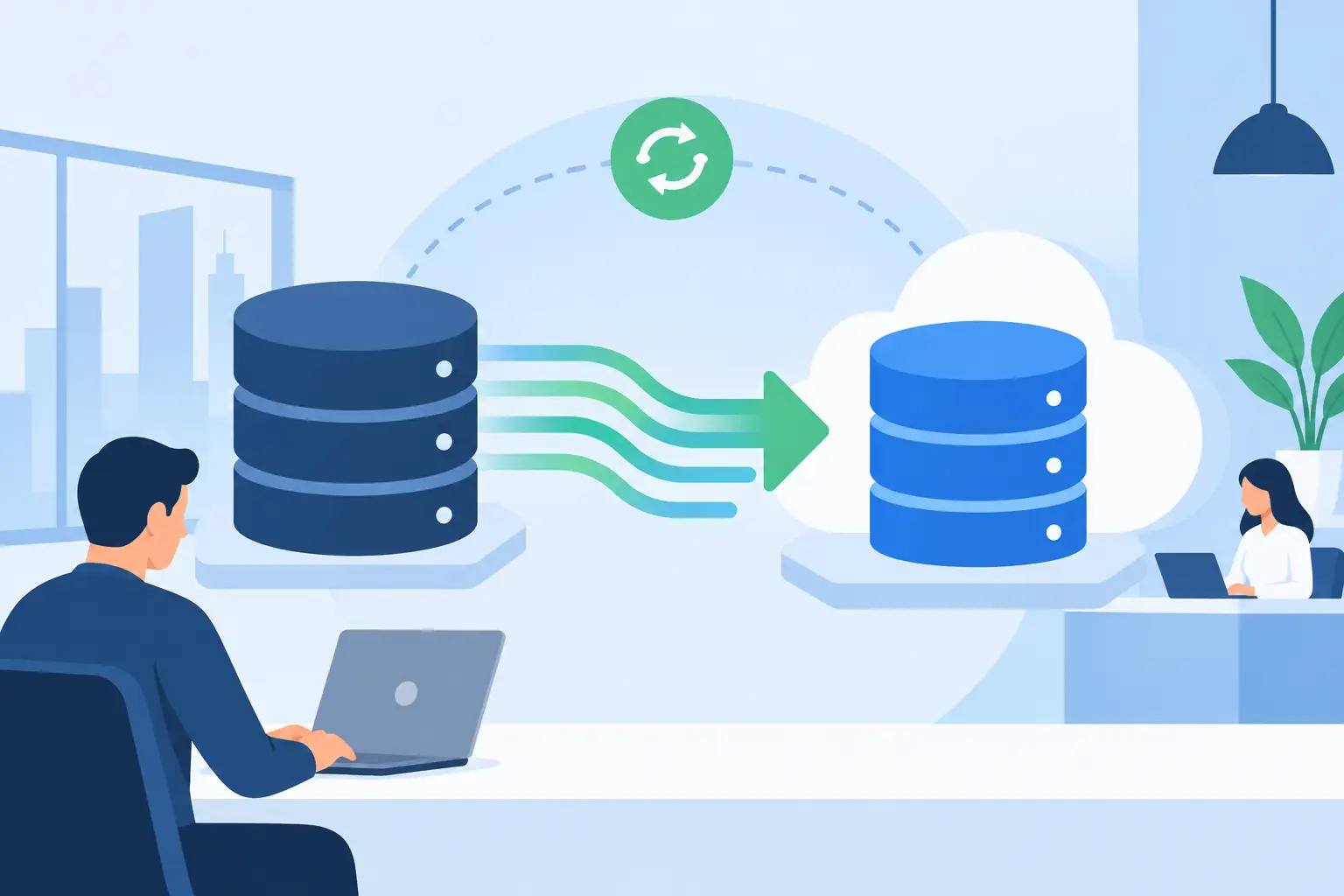
A poorly planned data migration fails not only when information is lost. It also fails when it forces sales to stop, alters financial reports, degrades the performance of a critical application, or leaves the team without a reliable way to roll back. Therefore, understanding how to migrate databases starts with treating the project as a business intervention with technical implications, not just a simple copy between servers.
For a CTO, CIO, or operator responsible for critical systems, the goal is not just to move tables. It is to preserve data integrity, maintain operational continuity, and leave a platform that is easier to operate, scale, and secure. The chosen technology matters, but the execution method determines the outcome.
The migration begins before extracting a single piece of data
The first common mistake is deciding the destination before understanding the source. A legacy database may contain undocumented dependencies, overnight batch processes, third-party integrations, queries embedded in old applications, or business rules maintained directly in stored procedures. If these elements are not identified at the outset, they appear as issues when the margin for correction is already limited.
A rigorous diagnosis must answer specific questions: which applications read and write to the database, what volume grows each month, which data have retention requirements, what maintenance windows exist, and what level of downtime each process tolerates. It is also advisable to identify read-only users, analytical loads, replicas, export interfaces, and authentication dependencies.
Not all migrations pursue the same goal. Some seek to move away from an unsustainable infrastructure; others need to reduce costs, improve availability, adopt a cloud architecture, or separate a monolithic application. The technical approach changes depending on the case. Migrating a relational engine to a newer version does not carry the same risk as moving from a relational model to a distributed one, nor does it compare to consolidating several databases after an acquisition.
Classify the data and its dependencies
Before designing the migration path, classify the information according to its criticality, sensitivity, and usage pattern. Transactional data from orders, payments, or inventory requires different controls than historical data used only for analysis. Personal, financial, or regulated information adds encryption, traceability, and access requirements that must be maintained throughout the process.
This phase also allows for the detection of a common problem: the organization attempts to migrate data that it no longer needs. Cleaning up obsolete records, unifying formats, and removing duplicates before the transfer can reduce cost, time, and complexity. However, this cleanup must be governed. Deleting information without an approved retention policy can pose a greater risk than transferring it.
How to migrate databases with an appropriate strategy
The strategy must balance operational continuity, cost, speed, and reversibility. There is no universally superior option. The decision depends on the size of the database, the tolerance for disruption, the type of engine, the internal capacity of the team, and the complexity of the connected applications.
An offline migration is usually sufficient when there is a realistic maintenance window and the volume of data is moderate. Writes are stopped, a consistent copy is made, it is restored at the destination, and the application is switched. It is a straightforward approach that is easy to verify, but it may be unfeasible for operations that run continuously.
When the business cannot accept a prolonged stop, it is often necessary to combine an initial load with replication or change capture. First, the existing data is copied, and then the changes made at the source are synchronized until the cutover moment. This strategy reduces downtime, although it introduces more components, requires close monitoring, and makes it essential to validate consistency between both environments.
In complex transformations, it may be preferable to run both platforms in parallel for a limited period. This offers greater control and allows for result comparison, but it increases operational costs and the risk of divergence if writes are not carefully coordinated. Maintaining two sources of truth for too long is usually a bad practice, so the coexistence period should have a clear end date.
Define the cutover and rollback plan
The cutover plan must describe who makes decisions, what checks enable the transition to the new environment, and under what conditions the change is aborted. It is not enough to reserve an hour on the calendar. There must be responsible parties for infrastructure, development, security, operations, and business, as well as a communication channel and escalation criteria.
The rollback plan deserves the same level of detail as the migration. If the new system has errors after the cutover, how are the writes made recovered? Which application points back to the source? How long can that option be maintained? A theoretical rollback that has not been tested is not an operational guarantee.
Execute in controlled environments before production
The first complete execution should not take place in production. A rehearsal with a representative copy of data allows for measuring extraction, loading, indexing, and synchronization times. It also exposes coding issues, incompatible data types, referential constraints, permissions, storage limits, and queries that lose performance at the destination.
It is advisable to document the process as a repeatable sequence, automated whenever possible. Manual steps multiply the risk, especially when multiple teams are involved or work outside of hours. Automation does not eliminate the need for supervision, but it reduces variations between rehearsals and facilitates subsequent auditing.
During execution, monitor both the source and destination platforms. An aggressive extraction can degrade the service that customers are still using. Limiting the load, scheduling intensive operations, and measuring application latency helps prevent the migration itself from becoming a production incident.
The four signals that should be continuously monitored are replication lag, error rate, resource consumption, and the integrity of transferred data. A technical dashboard is useful, but it needs defined thresholds and responsible individuals to act when they are exceeded. Measuring without a planned response provides little protection.
Validation is not just counting rows
Comparing the number of records is necessary, but far from sufficient. Two tables may have the same number of rows and still contain truncated values, incorrect time zones, broken relationships, or inconsistently transformed data. Validation must combine technical checks and functional tests.
On the technical side, it is advisable to verify schemas, primary keys, indexes, constraints, sequences, permissions, hashes or checksums, and counts by relevant segments. On the functional side, users and process owners must check real operations: creating an order, issuing an invoice, querying a history, executing a close, or generating a critical report.
Performance is also part of validation. A query that returns correct results but takes ten times longer can block adoption and affect service level agreements. Analyze execution plans, index configuration, concurrency, and environment sizing before declaring the migration complete.
Design the post-operation, not just the transfer
A newly migrated database needs verified backups, monitoring, access management, patches, alerts, and recovery procedures. If the destination is in the cloud, it also requires a clear cost discipline: storage, transfers, replicas, reserved capacity, and managed services can grow rapidly without a governance policy.
The documentation should reflect the resulting architecture, data flows, responsible parties, and decisions made. This investment reduces dependence on individual knowledge and allows internal teams to operate the system with greater autonomy. In modernization projects, the goal should not be to replace a technical dependency with an external one.
StrateCode addresses these types of initiatives by combining architectural diagnosis, technical execution, and operational criteria. This combination prevents separating the strategic decision from the reality of implementation, especially when there are legacy systems, critical applications, and demanding availability requirements.
A well-executed migration leaves something more valuable than a database on a new platform: it leaves an organization capable of understanding, governing, and evolving the information on which its business depends.