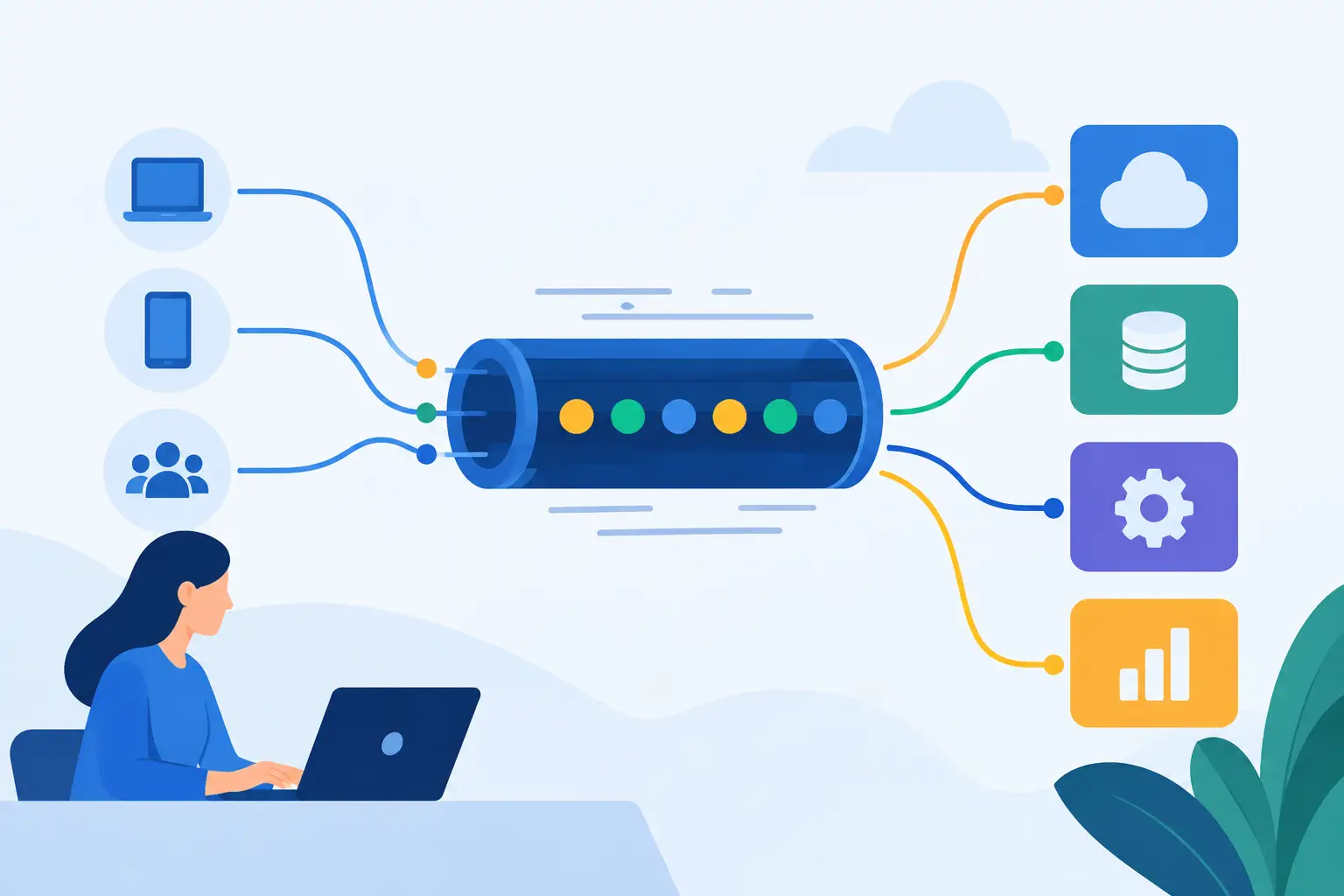
An approved order that does not update inventory until hours later, a customer onboarding that requires three teams to intervene, or a confirmed payment that blocks secondary processes are symptoms of a coupling problem. The question is not whether event technology is trendy, but when to adopt event-driven architecture to eliminate dependencies that are already harming operations.
This model can provide responsiveness, scalability, and better integration between business domains. It can also multiply complexity if introduced without a clear use case, data governance, or operational capability. The decision should be based on the actual workflow, the cost of failures, and the company's modernization horizon.
When Adopting Event-Driven Architecture Makes Sense
An event-driven architecture is suitable when relevant business changes must trigger actions in multiple systems, but not all need to respond at the same moment or depend on a synchronous response to complete their tasks.
Consider a B2B commerce platform. When an order is confirmed, billing must create the corresponding document, the warehouse must prepare the shipment, analytics must update forecasts, and customer service can send a notification. If the order system directly calls each application, each integration increases the dependency on the core business. A temporary outage of a peripheral service can even prevent the sale from being recorded.
With events, the system publishes that the order has been confirmed. Interested consumers process that fact according to their own needs and rhythms. The sender does not need to know the implementation, availability, or internal evolution of all of them.
Adoption is especially justified when several of these conditions are met:
- A single business event activates processes in three or more applications or teams.
- Load peaks are irregular, and subsequent processes can be executed asynchronously.
- The organization needs to decouple a legacy system without replacing it all at once.
- Delays between areas generate manual errors, loss of visibility, or measurable operational costs.
- There are needs for auditing, traceability, or reconstruction of states from relevant changes.
No isolated signal forces a change in architecture. A flow with two systems, low volume, and a legitimate synchronous dependency can be better resolved through a well-designed API. The value of events appears when they reduce an existing complexity, not when they add a technical layer in anticipation.
Operational Signals to Measure Before Deciding
The conversation should start outside the infrastructure diagram. It is advisable to identify which processes are delayed, how much it costs to reconcile data, and which applications become bottlenecks during an incident.
A common signal is the proliferation of point-to-point integrations. The CRM calls the ERP, the ERP updates a logistics application, and this feeds a reporting tool. Each change in a contract requires coordinating deployments, testing combinations, and assuming regression risks. Event-driven architecture can replace part of that chain with a controlled distribution of business events.
Another signal is the need to process load at different speeds. A transaction capture system may receive thousands of operations in a few minutes, while a reporting engine can process them later. Separating both speeds avoids over-sizing components that do not require immediate response and allows for absorbing peaks with greater predictability.
It is also important to assess the autonomy of teams. When different domains - sales, operations, finance, or support - evolve at different rates, event-based communication can reduce the technical coordination needed. However, autonomy does not mean the absence of shared rules. The names of events, the data they contain, and their lifecycle must be governed.
What an Event-Based Architecture Does Not Solve
Events do not correct inconsistent master data, poorly defined processes, or ambiguous business responsibilities by themselves. If each department interprets differently what "active customer" or "completed order" means, distributing those concepts will only propagate inconsistency more quickly.
They are also not the ideal choice for every interaction. Checking a current balance, validating credentials, or reserving a resource that requires immediate confirmation usually needs synchronous communication. In these cases, an API or a direct call may be clearer and easier to operate.
The main mental shift is to accept eventual consistency. After publishing an event, some systems may take seconds or minutes to reflect the new state. This is acceptable for updating a dashboard or sending a communication, but perhaps not for authorizing a payment or releasing limited merchandise. Tolerance for lag must be defined with business stakeholders, not deduced solely from engineering.
Designing Events as Business Contracts
A common mistake is publishing events that reflect internal tables: `customer_updated`, with dozens of fields from a database, without context about the change that occurred. This approach exposes implementation details and turns any schema modification into a risk for all consumers.
It is preferable to express stable domain facts, such as `order_confirmed`, `invoice_issued`, or `shipment_delivered`. Each event should answer a specific operational question: what happened, when it happened, what entity is affected, and what minimum information does a consumer need to act.
The evolution of contracts deserves the same rigor as a public API. Adding fields is usually less problematic than removing or changing their meaning, but both decisions must be versioned and communicated. A catalog of events, functional owners, and compatibility criteria prevent the event bus from becoming an opaque dependency.
Idempotency, Retries, and Expected Errors
In distributed systems, a consumer may receive the same message more than once. It may also fail after executing part of its work. Therefore, processes must be idempotent: processing a repeated event should not duplicate an invoice, a reservation, or an email.
Retries require limits, observability, and routes for messages that cannot be processed. It is not enough to store failures in a separate queue. There must be a clear responsibility to investigate them, correct data when appropriate, and safely reintroduce the work. Daily operations determine the success of the architecture as much as the choice of platform.
End-to-End Traceability
When a transaction passes through several consumers, the team needs to quickly answer simple questions: what happened to this order, which service processed it, and where was the delay? For this, events must include correlation identifiers, and metrics must show latency, volume, errors, and the age of pending messages.
This visibility has a direct impact on business. It reduces diagnosis time during incidents, allows identifying unmet service level agreements, and prevents reconciliation from relying on spreadsheets or manual queries.
A Controlled Risk Adoption Path
Modernization rarely requires transforming the entire organization at once. The most prudent approach is to select a limited, frequent flow with a known failure cost. For example, the propagation of confirmed orders from a commercial system to billing and logistics.
First, the canonical event and the expected outcomes should be established: fewer manual interventions, shorter update times, or reduced reconciliation errors. Then, one consumer is incorporated at a time, maintaining comparison mechanisms with the current process for a limited period. This phase allows validating data quality, behavior under retries, and actual load.
The choice of technology should come after defining the operational pattern. A broker, a streaming platform, or a managed queue respond to different needs for retention, order, volume, cost, and internal experience. Adopting a powerful tool without the ability to manage, monitor, and secure it can shift the problem to another layer.
It is also advisable to establish from the beginning who owns each event, who approves contract changes, and which teams handle incidents. Distributed architecture without a distributed responsibility model creates gray areas precisely when the most pressure exists.
The Right Decision Starts from the Process, Not the Pattern
Adopting events is worthwhile when the company needs business facts to circulate reliably between systems that must evolve independently. It is less worthwhile when used to disguise confusing business logic or to avoid a necessary conversation about data, ownership, and operation.
The best starting point is a flow with measurable impact, clear boundaries, and both technical and operational sponsorship. If that first case reduces real friction without losing control, the architecture will have a solid foundation to grow where it adds value.