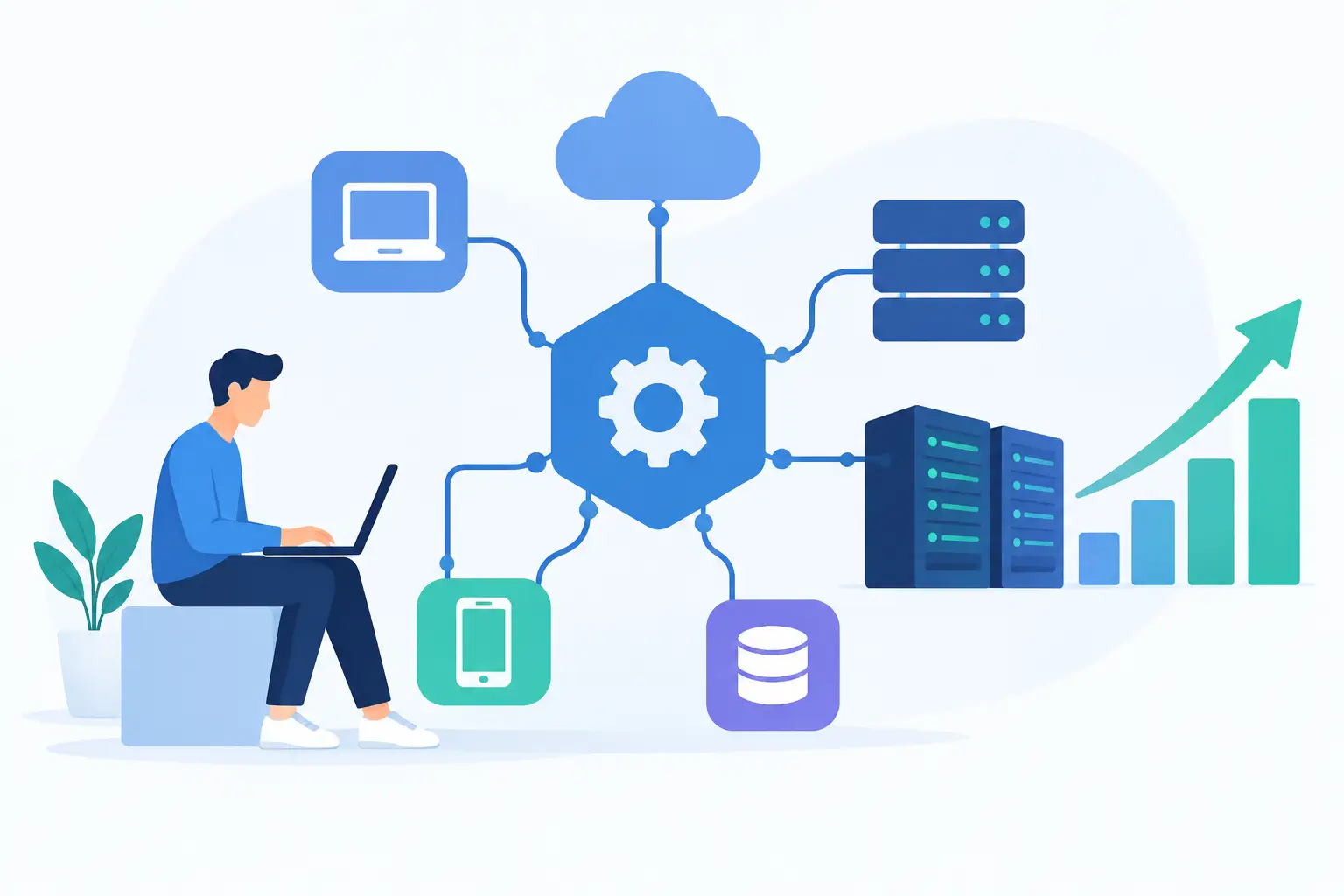
An enterprise API is not just a layer to connect applications. It is an operational contract between teams, systems, partners, and products that will evolve at different rates. This enterprise API design guide addresses the decisions that determine whether those integrations reduce friction and costs or, conversely, multiply dependencies, incidents, and technical debt.
For a CTO, CIO, or operations manager, the goal should not be to publish more endpoints. It should be to create predictable, secure, and governable interfaces that allow internal processes to change without breaking those who depend on them. That outcome requires architectural discipline, a clear operating model, and investment criteria aligned with the impact of each API.
Start with the business domain, not the database
Many APIs fail from their initial design because they directly expose tables, internal entities, or limitations of a legacy application. It may seem like a quick way to integrate systems, but it turns every internal change into a risk for external consumers.
The starting point should be the business domain: customers, orders, contracts, inventory, authorizations, or any capability that has stable meaning for the organization. An orders API, for example, should describe actions and states that the business recognizes, not replicate the table structure of an ERP.
This separation has a practical consequence: the API can maintain a consistent contract even if internal components are replaced, the source system is modernized, or responsibilities are redistributed among services. It does not eliminate complexity, but it avoids transferring it unfiltered to each consumer.
Before defining resources and operations, it is advisable to answer four questions: who consumes the API, what decision or process does it enable, what data does it really need, and what is the cost of returning incorrect information or being unavailable. These answers allow distinguishing a low-risk internal API from an interface that supports critical operations, integrations with customers, or regulatory requirements.
Define contracts that withstand change
An API contract must be explicit. It includes routes, methods, request and response structures, status codes, validation rules, pagination, filters, errors, and performance expectations. If an aspect is left implicit, each team will interpret it differently, and the integration will depend on fragile assumptions.
Consistency matters more than individual preference. If an API uses plural names, filters with a specific syntax, and standardized error formats, those decisions must be maintained throughout the catalog. Consistency reduces onboarding time, simplifies common tools, and decreases incidents caused by ambiguous interpretations.
Design responses for consumers, not for internal convenience
Not every internal entity should appear in a response. Exposing extra fields increases security risk, couples consumers to unnecessary details, and complicates future modifications. A response should contain the necessary information to complete the use case, with stable and documented semantics.
It is also advisable to separate query operations from operations that change state. The former usually require pagination, sorting, and filters. The latter need clear validations, traceability, and idempotency when a repetition could generate a duplicate effect, such as creating a payment, issuing an order, or initiating a provision.
Idempotency deserves special attention in distributed flows. Networks fail, clients retry, and asynchronous processes can deliver messages more than once. If a critical operation does not allow controlled repetitions, a transient failure can become an operational or financial problem.
Version with criteria and avoid silent changes
An incompatible modification should not come as a surprise. Removing a field, changing its type, altering a validation rule, or modifying the meaning of a state can break processes that the API owner team does not control.
Versioning does not have a single correct form. A version in the path may be clear for public APIs; negotiation through headers may fit better in certain internal environments. What matters is to establish a policy: what is considered an incompatible change, how it is communicated, how long versions coexist, and how consumer migration is measured.
Avoid creating a new version for every minor adjustment. Adding optional fields or new endpoints can be done compatibly if consumers are designed to ignore unknown data. The key is to preserve semantics: an existing field should not change meaning without a controlled transition.
Integrate security into every design decision
Authentication answers who is making a call. Authorization determines what can be done. Treating both as a post-configuration often results in APIs that validate identities correctly but expose data or actions outside the permitted perimeter.
The permission model should start from business responsibilities and data sensitivity. A support system may query the status of an order, but not necessarily modify commercial conditions. A supplier may update assigned inventory but not access information from other suppliers. These restrictions should be applied at the authorization layer and, when necessary, at the resource and field level.
Service credentials, short-lived tokens, secret rotation, and encryption in transit are basic controls, not differentiators. For APIs with sensitive information, add audit logs that indicate who accessed, what action was executed, on what resource, and with what result.
Do not forget protection against abuse. Rate limits, quotas, and payload size restrictions preserve availability and contain integration errors. Their configuration depends on the usage pattern: an API for overnight synchronization requires different limits than an interface that supports real-time transactions.
Governance: assign ownership and decision rules
An API without an owner tends to degrade quickly. No one decides priorities, no one maintains documentation, no one is accountable for compatibility, and changes occur under pressure. Each API must have a responsible team, a functional owner when appropriate, and a defined channel for consumers.
Governance does not require a central bureaucracy to approve every field. It requires reusable standards and traceable decisions. An architecture committee can establish conventions, security requirements, observability rules, and criteria for publishing external APIs. Product teams retain the autonomy to implement within that framework.
An updated catalog helps avoid duplicate integrations and hidden dependencies. It should indicate purpose, owner, known consumers, data classification, service level, version, and lifecycle. This visibility allows detecting critical APIs that depend on a single person, services with no real use, or interfaces that should be retired.
Design the operation before the incident occurs
An API in production needs metrics that allow answering specific questions: is it available?, how long does it take?, what errors does it return?, which consumers generate the most traffic?, which dependency is failing? Without observability, the team works from perceptions and incomplete tickets.
At a minimum, measure request volume, latency per endpoint, error rates, resource saturation, and results from external dependencies. Correlate each request with a traceability identifier that crosses gateways, services, queues, and source systems. In an incident, that correlation can reduce hours of diagnosis to minutes.
Service level agreements must be realistic. Promising extreme availability for an API that depends on batch processes or an external provider creates an expectation that is impossible to meet. It is preferable to define objectives based on criticality, communicate maintenance windows, and design controlled degradations when a dependency fails.
For long-running processes, synchronous response is not always suitable. An asynchronous pattern, with initial acceptance, status querying, and event notifications, can offer better reliability and operational experience. The trade-off is greater complexity for consumers and support, so it must be justified by the process, not by architectural fashion.
Apply an enterprise API design guide with automated controls
Manual review of each contract does not scale when multiple teams publish services. Automation turns agreed rules into repeatable controls: specification validation, compatibility testing, security analysis, documentation generation, and contract testing between producer and consumer.
The contract-first approach often works well in organizations with multiple integrations. The contract is defined and reviewed before implementation, allowing ambiguities with product, security, and consumers to be detected before investing in development. It does not replace architectural decisions, but it makes them visible and verifiable.
Test environments should represent relevant cases without exposing production data. Synthetic data, simulators, and contract testing are especially useful when an integration depends on third parties or on legacy systems that are difficult to replicate. The goal is not to eliminate all uncertainty but to find incompatibilities before deployment.
Prioritize by value and risk, not by technical completeness
Not all APIs require the same investment. An internal API with two stable consumers may need simpler controls than a platform for customers, distributors, or external developers. Oversizing governance slows down delivery; undersizing it shifts the cost to incidents, support, and urgent migrations.
Good prioritization combines business impact, data sensitivity, number of consumers, operational dependency, and expected pace of change. With these criteria, the organization can decide where to apply high availability, enhanced security review, expanded support, or formal withdrawal plans.
Enterprise API design is an ongoing discipline, not a deliverable that ends when the first version is published. When the contract, ownership, and operation are treated as part of the product, the API stops being a one-off integration and becomes a capability that allows modernizing systems without stopping the business.