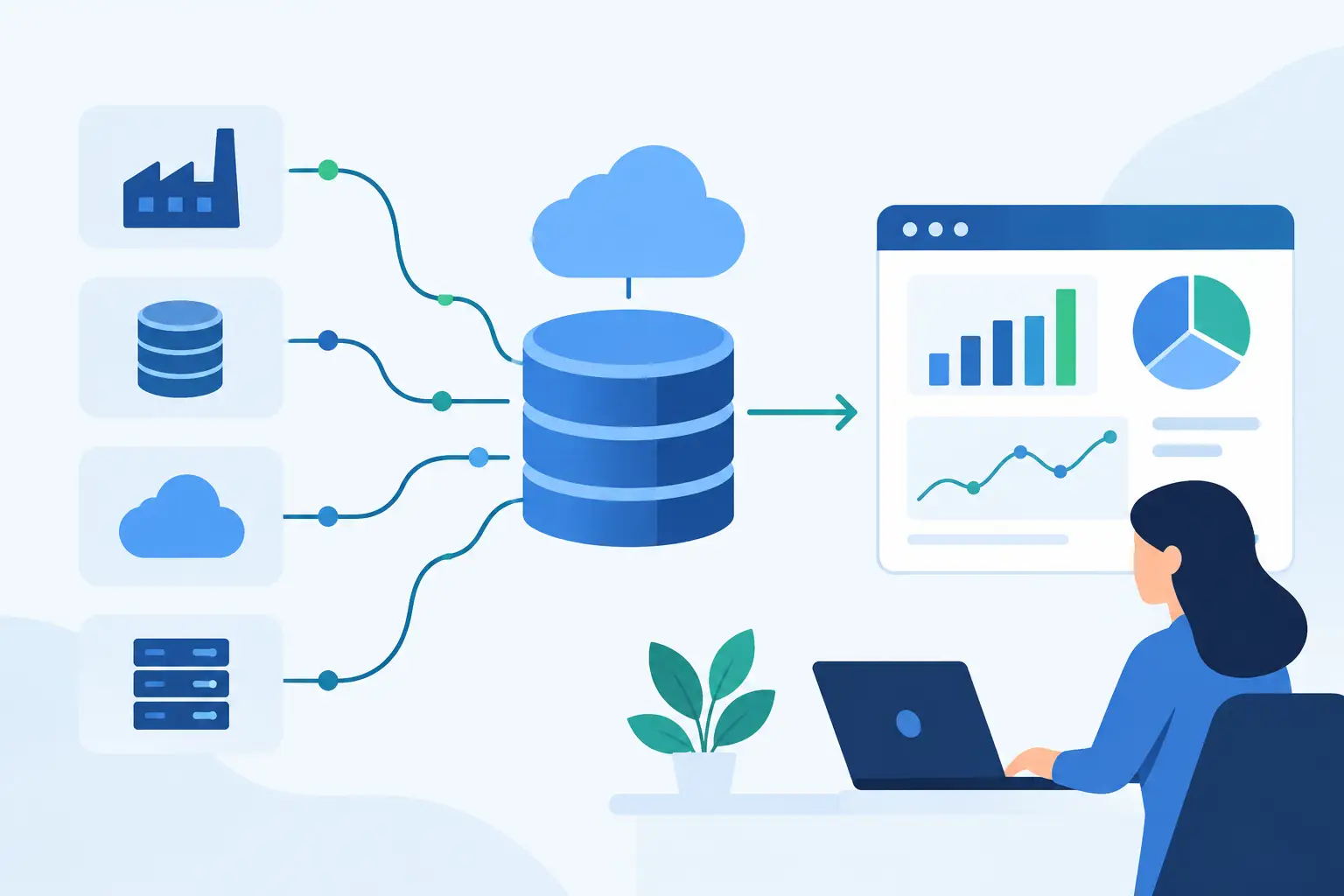
When operations work in an ERP, sales in a CRM, warehouse in a proprietary application, and finance in spreadsheets, the problem is not just the lack of visibility. Late decisions, manual reconciliations, inventory errors, and processes that are difficult to scale also arise. This operational data integration guide explains how to address this problem with architectural criteria and without turning integration into another fragile system to maintain.
The goal is not to move data from one platform to another just because it is technically possible. It is about ensuring that each area has reliable information, with the appropriate latency and a shared meaning, to better execute its processes. This requires combining data design, business priorities, security, and a clear operational discipline.
What an operational data integration should resolve
Operational data describes what is happening in the company: orders, stock levels, incidents, shipments, invoices, customers, production statuses, or response times. Unlike purely analytical data, they are usually directly involved in daily execution. A duplicated or outdated data point can block an order, generate an incorrect invoice, or lead a team to act on incorrect information.
Therefore, a well-planned integration must resolve four issues. First, which system is the source of truth for each entity. Second, which data should circulate and how often. Third, how they are transformed without losing traceability. Fourth, what happens when a system does not respond, a data point does not validate, or a process needs to be repeated.
The answer is not always real-time synchronization. For critical stock updates or order status, a few minutes can be excessive. For financial consolidation or certain internal reports, a nightly load may be sufficient and much more economical to operate. The architecture must respond to the impact of the delay, not to a technological preference.
Start with the process, not the tool
The common mistake is to select an integration platform before defining the operational flow that needs improvement. Tools can accelerate delivery, but they do not correct ambiguous business rules or resolve poorly assigned data ownership.
The first task is to map a complete process, from the event that initiates it to the expected outcome. For example, in an order-to-cash flow, it is important to identify when the order is created, who validates the credit, where the inventory is reserved, which system issues the invoice, and what status the customer sees. This exercise reveals duplications, manual steps, and dependencies that rarely appear in a high-level systems diagram.
Next, classify integrations by value and risk. A flow that prevents billing errors or reduces cancellations typically has higher priority than a synchronization aimed at administrative convenience. You should also distinguish between read integrations, which expose data for querying, and write integrations, which modify record systems and require stricter controls.
Define owners and sources of truth
Each key entity needs an explicit owner. The CRM can be the source of truth for customer commercial data, while the ERP is for payment and billing conditions. If two systems can modify the same field without a precedence rule, the integration will end up propagating conflicts.
It is not enough to document it in a presentation. The rules must materialize in interface contracts, validations, and permissions. If the ERP rejects an address due to format, the CRM should not mark the synchronization as completed. There must be a visible error state, a responsible party, and a correction procedure.
Choose an appropriate integration pattern
There is no single correct architecture. The choice depends on the number of systems, volume, criticality of flows, capabilities of existing applications, and the operational maturity of the team.
Point-to-point integrations can be reasonable for few systems and limited processes. They are quick to implement, but their cost grows non-linearly: each new system adds connections, transformations, and error cases. In environments with multiple critical applications, it is advisable to introduce an integration layer that centralizes authentication, transformation, monitoring, and access policies.
APIs are suitable for queries and transactional operations with immediate response. Events are preferable when multiple consumers need to react to a change, such as the creation of an order or the update of a shipment. Batch processes remain useful for large volumes, legacy systems, or tasks with a wide update window.
A common and robust pattern combines the three approaches. An API allows querying the status of an order, an event communicates that the order has changed, and a batch load reconciles historical information or corrects deviations. Trying to impose real-time on all data often raises costs and complexity without providing equivalent value.
Design the integration to fail in a controlled manner
In production, failures are not an exception. APIs impose usage limits, networks have interruptions, providers change formats, and legacy systems may return incomplete responses. A mature integration assumes this reality from the design stage.
Idempotency is essential in operations that can be retried. If a message is delivered twice, the receiving system should not create two orders or issue two invoices. Retries with exponential backoff, queues to decouple systems, and compensation mechanisms when a distributed transaction cannot be completed are also necessary.
Observability must be part of the initial scope. Each flow needs correlation identifiers, structured logs, and metrics that allow answering specific questions: which messages have failed, where they have stopped, how long they take, and how many have been processed correctly. A dashboard with general indicators does not replace the ability to track a specific order across systems.
Keep errors out of the shadows
Error logs are not an operational solution if no one reviews them. Set alerts based on criticality and a management circuit for repeatable incidents. Some can be corrected automatically, such as a temporary connection error. Others require functional intervention, such as a non-existent product code or a customer blocked due to credit.
It is advisable to separate technical errors from data quality errors. The former usually corresponds to technology; the latter often relates to a process owner. Mixing them in the same queue slows down resolution and dilutes responsibilities.
Governance and security: design requirements
Integrating operational data expands the risk surface. Shared credentials, excessive permissions, and uncontrolled copies of sensitive information can turn an efficiency improvement into a compliance and security problem.
Apply the principle of least privilege: each integration should only access the data and actions it needs. Use differentiated service identities, manage secrets outside of code, and log relevant write operations. When there are personal, financial, or sector-regulated data, also define retention, masking, and role-based access policies.
Governance should not block progress with endless committees. Its role is to establish repeatable decisions: nomenclature, interface versions, data owners, quality criteria, and approval processes for changes. Without these rules, each new integration introduces exceptions that raise maintenance costs.
A realistic roadmap for execution
Implementation should start with a high-value flow and controlled scope. A well-selected first case demonstrates the working model, validates technical decisions, and allows measuring results before extending the platform. The condition is that it should not be an isolated prototype: it must use from the beginning the security, monitoring, and deployment standards that will be applied later.
In the discovery phase, document systems, owners, available interfaces, data quality, volumes, and business constraints. Then define the data contract, exception scenarios, and acceptance criteria. Tests should include not only the correct path but also duplicates, failures, retries, incomplete data, and version changes.
Deployment requires a transition strategy. In some cases, a gradual activation will suffice; in others, it will be necessary to operate in parallel and reconcile results before retiring the previous process. The decision depends on the cost of an error and the possibility of reverting changes without losing information.
StrateCode addresses these types of initiatives by combining process diagnosis, architecture, and technical execution. This combination reduces the usual gap between a strategic recommendation and an operable system, with clear responsibilities and verifiable metrics.
How to measure if the integration is working
Success is not measured by the number of deployed connectors. It should be measured by operational results: reduction of manual reconciliations, shorter cycle time, fewer order errors, improved information availability, or decreased support incidents.
Add technical indicators that explain those results, such as latency, error rate, queued messages, retry percentage, and mean recovery time. If an integration meets its service agreement but generates recurring functional exceptions, it is not fulfilling its business purpose.
A well-designed operational data integration becomes almost invisible to users: the order arrives where it should, the inventory reflects reality, and teams stop chasing contradictory versions of the same information. Achieving that state requires architecture and discipline, but also the decision to treat data as a central part of the operation, not as a byproduct of applications.